





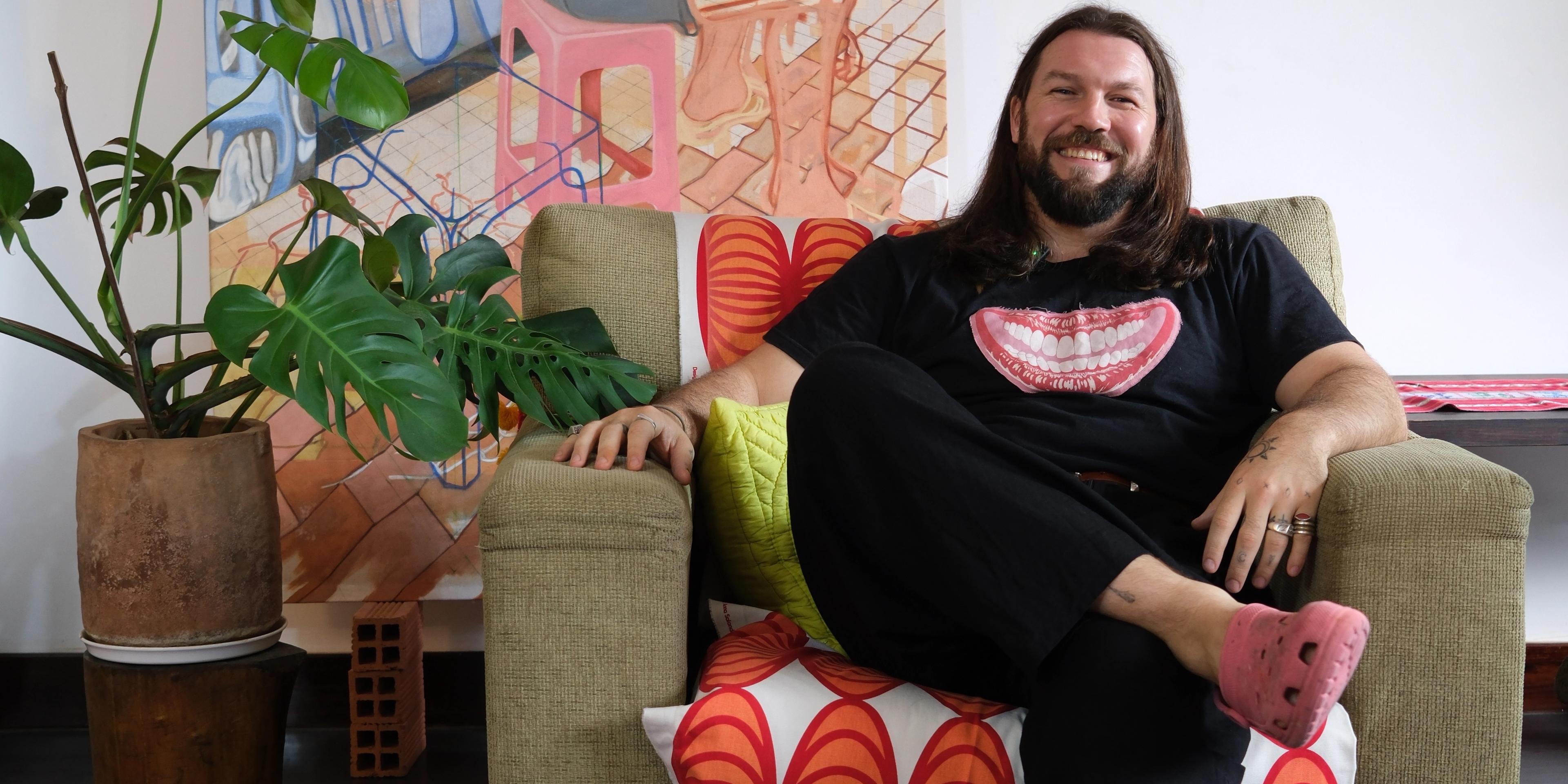
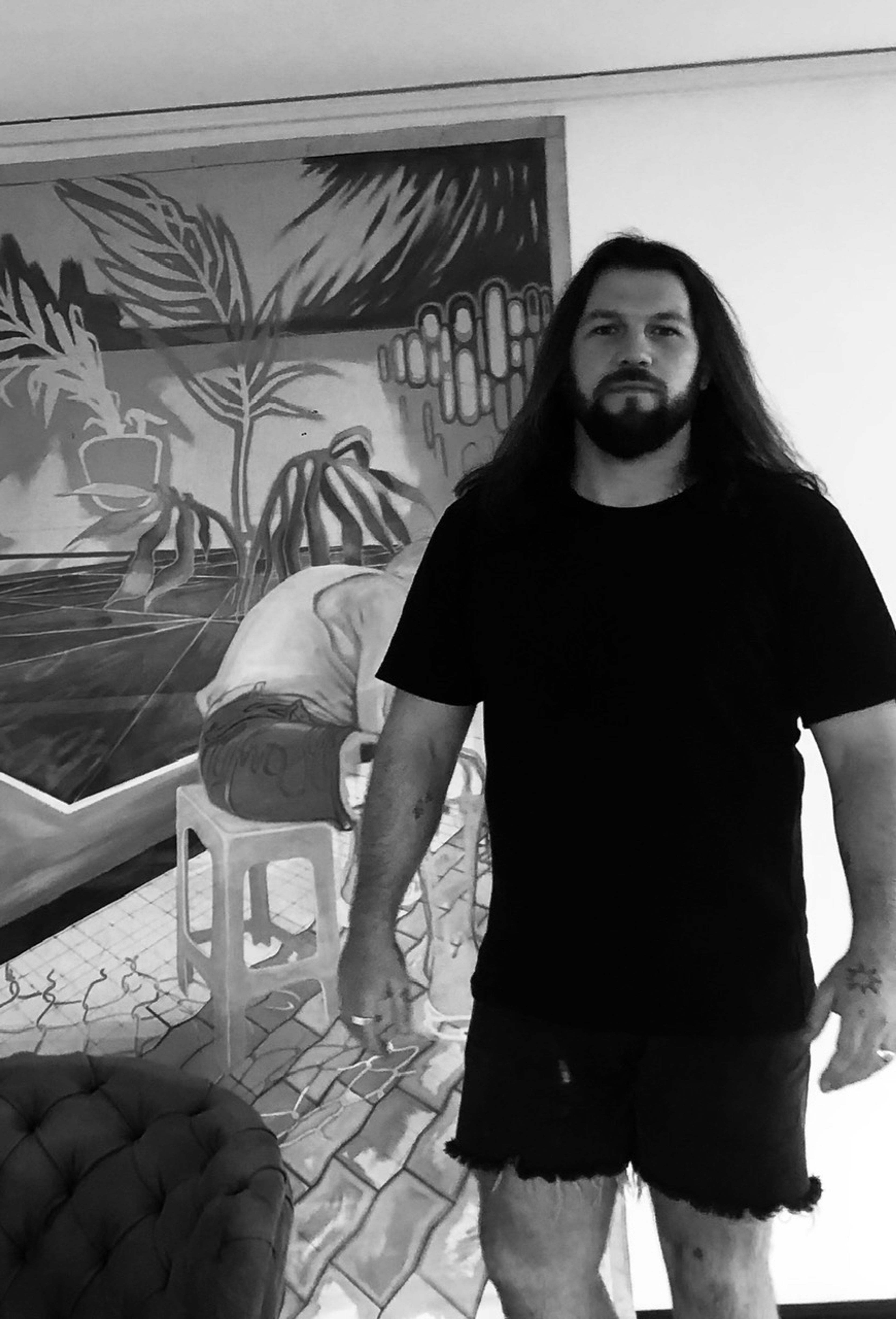
Ruairi greeted me at the door of his apartment on Nguyễn Đình Chiểu street. A custom-made t-shirt with a broad smile patched onto its chest was tucked into high-waisted black trousers, paired with bright pink Crocs on his feet. He grinned from cheek to cheek as he led me in. Ruairi has long, straight hair flowing down to wide shoulders built from years of rugby, a lumberjack’s beard, and tattoos dotting his arms and peeking out above his ankles. His apartment opens directly into a kitchen, with the living room to the right and his art studio off to the left. String curtains separate the living room from the kitchen—perfect for when inspiration strikes and he springs from the sofa over to his workspace. Once inside, he closed the door behind us. Perhaps out of habit, keeping the inspiration where he wants it to stay.
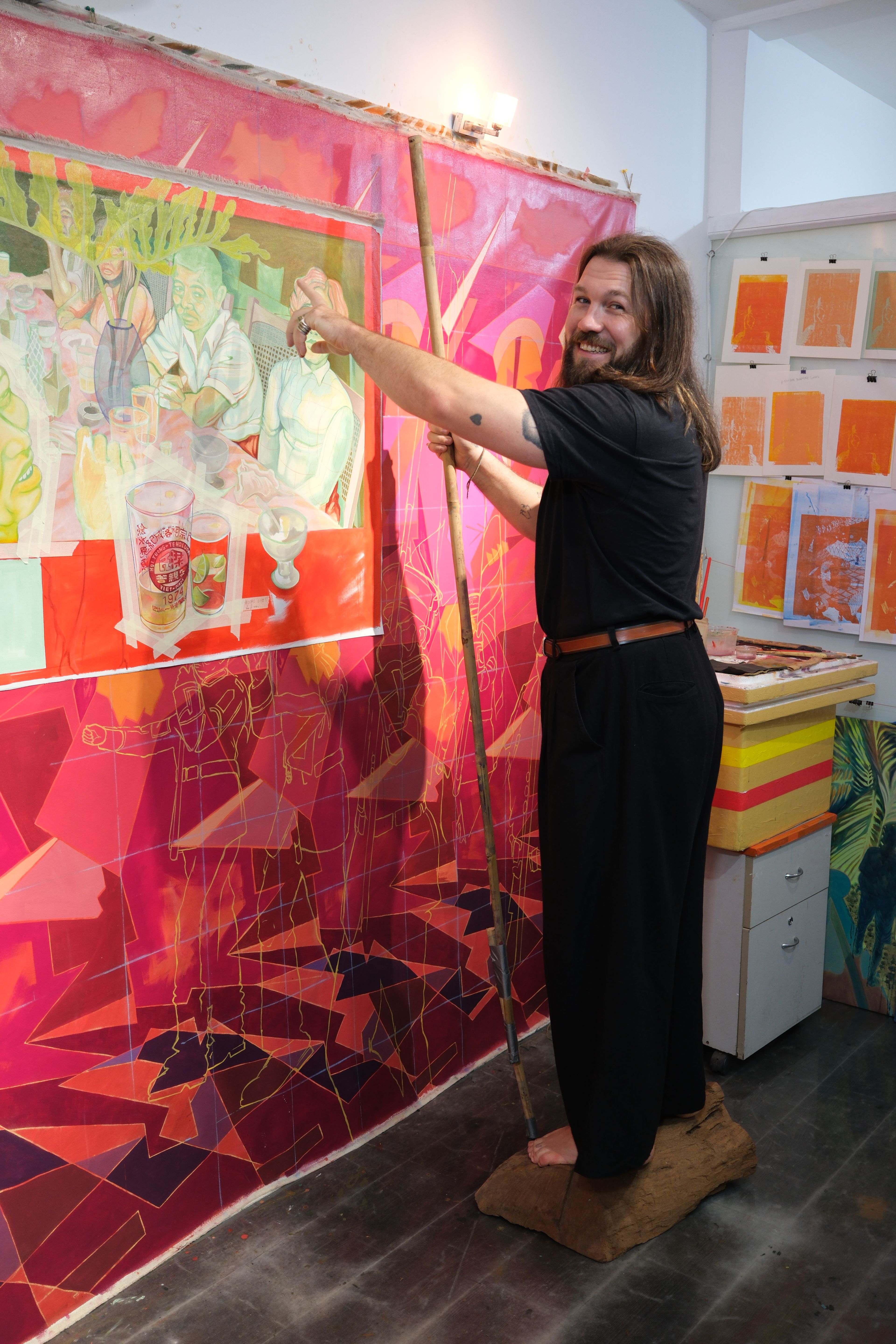
Ruairi's a full-time artist and so he said what I expected him to say. "This is where I spend most of my time." It’s quiet and windowless—the type of place Ruairi will sometimes lose track of the hours and end up staying there all day. He began to share everything he's working on, pulling out notebooks, photographs, wood panels, countless sketches, patches—all different parts and phases of his creative processes. Manic was the word he used to describe his artististry—an apt term considering he often has as many as seventeen projects going at once. Part of the reason is he simply loves to create. Another part is that he feels there’s danger to overdoing a project near completion. When you’ve been working on something for so long, you can feel attached to it, which can lead to last-minute decisions that might not make sense for the work. Therefore, leaving a project unfinished for a while allows time to pass so that you can return to it when the moment is right to apply final touches with respect to the piece.
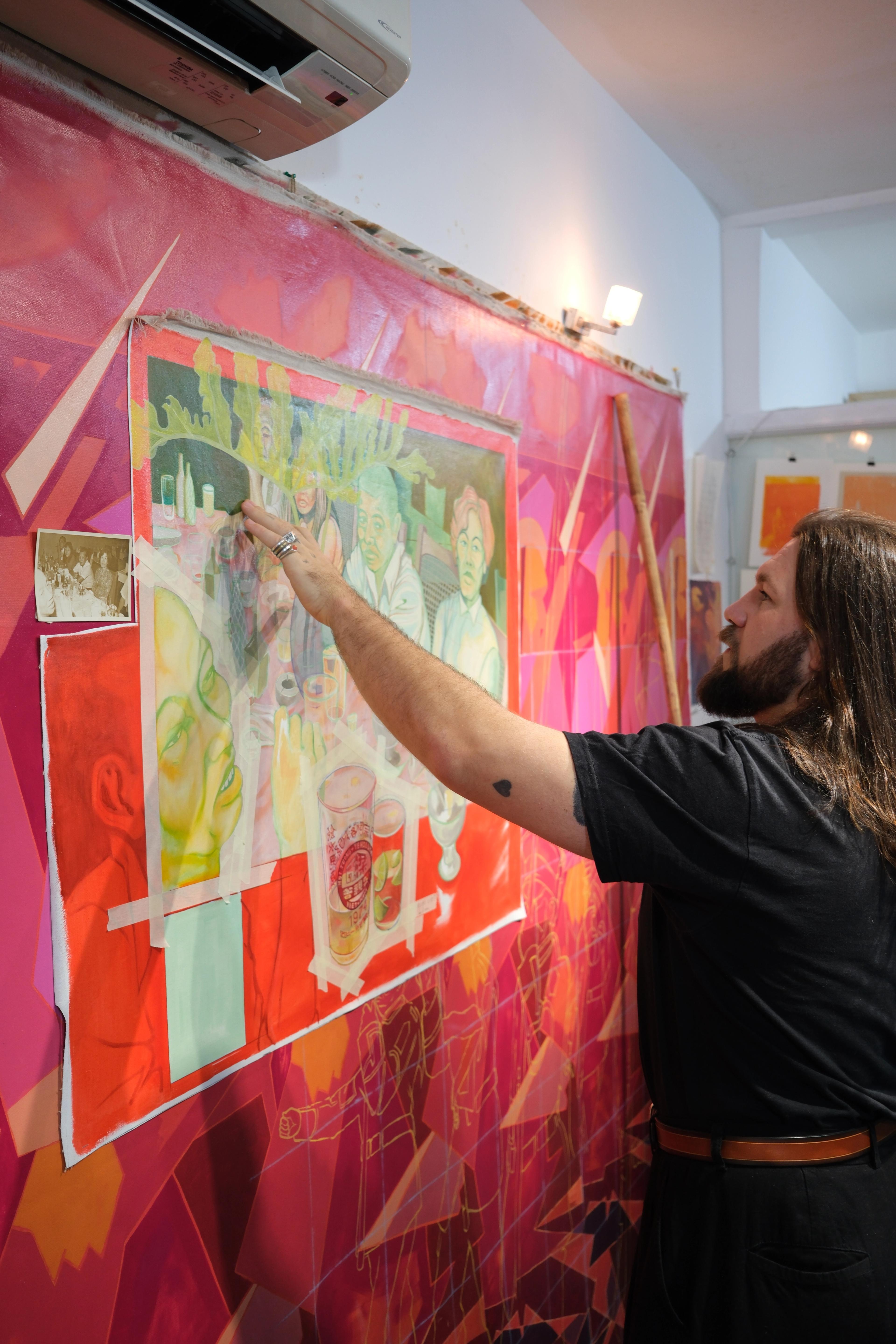
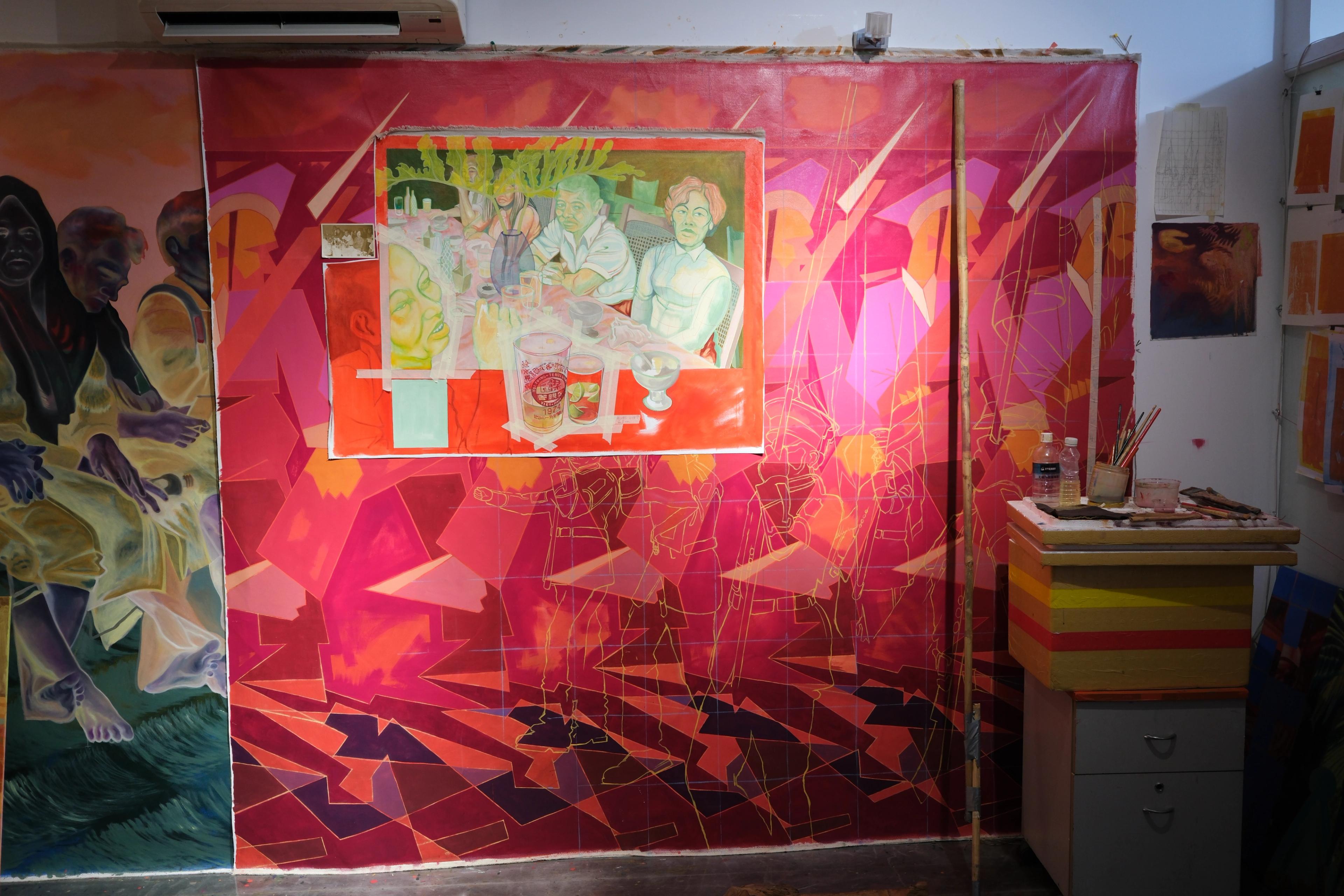
An example was a large oil-and-collage piece in its infancy on the back wall, tentatively titled Baba O'Riley—a nod to The Who song his mother played on loop during a summer back home, a tune that instantly transports him to her side whenever he hears it. Centered around a snapshot pulled from a bargain bucket at the tool market in District 5, the painting explores memory triggers, late-night nostalgia, and the strange loneliness of being surrounded by people and noise. Starting during travels around Ireland, for years Ruairi has collected physical photographs from markets, derelict houses, and street corners—what he calls "other people’s memories"—incorporating these adopted moments alongside his own life. On the canvas, what began as a routine dinner table scene was already being distorted into a hazy, late-night Saigon karaoke gathering.
Ruairi was born in Belfast, the capital and largest city in Northern Ireland. It is also an area historically related to The Troubles, a three-decade-long conflict between predominantly Protestant Unionists and Catholic Nationalists. In short, the former wanted Northern Ireland to remain part of the United Kingdom (UK), while the latter wanted to leave the UK and join the rest of Ireland as a unified country. Although he was born five years before the Good Friday Agreement peace deal was signed in 1998—largely putting an end to the widespread violence that occurred throughout his home—he identifies as someone who grew up in the post-Troubles era.
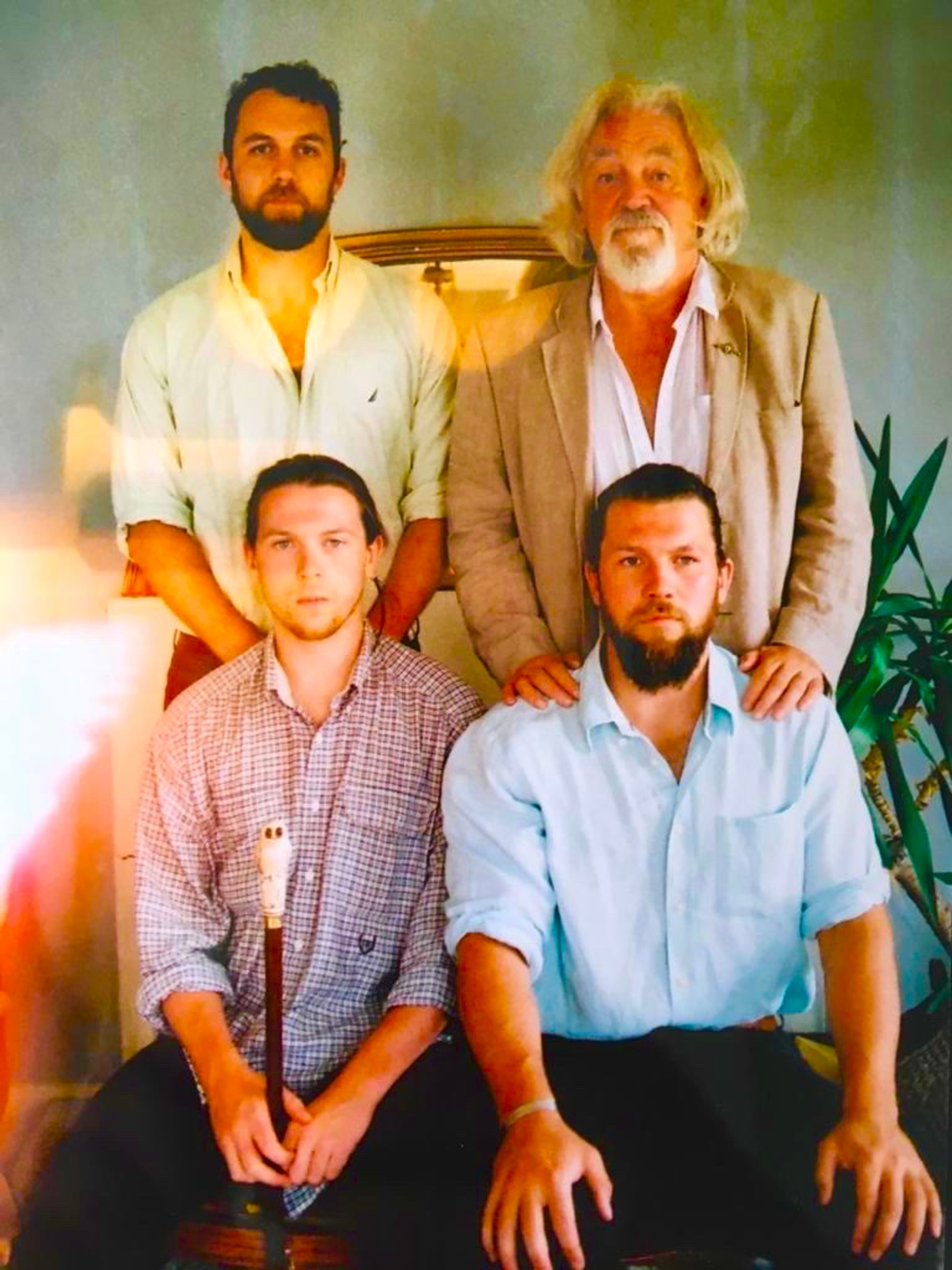
Nowadays, history and politics weave themselves in and out of his art, while he continues to understand how his roots have shaped his existence. However, as much as he is a product of the times he grew up in, he is also a product of his environment. The way Ruairi passionately rants about the world makes sense when you consider his upbringing. A middle child wedged between two brothers—one who he still bonds with discussing geopolitics on long-distance phone calls and the other who restores historic buildings and collaborates with Ruairi on screen-printing t-shirts—Ruairi has always had an appetite for understanding how identity changes with time and memory, whether that’s through conducting conversation or constructing art.
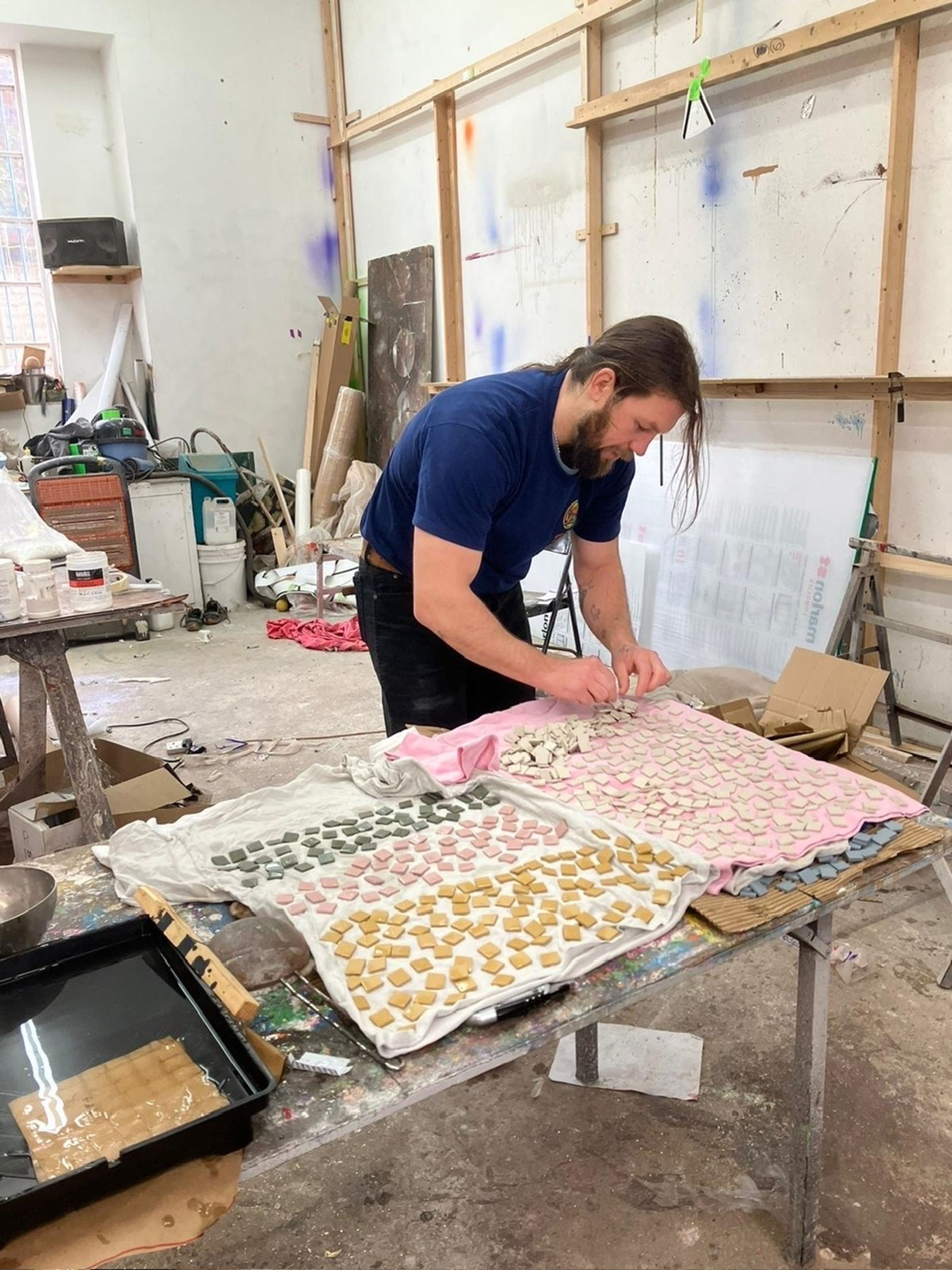
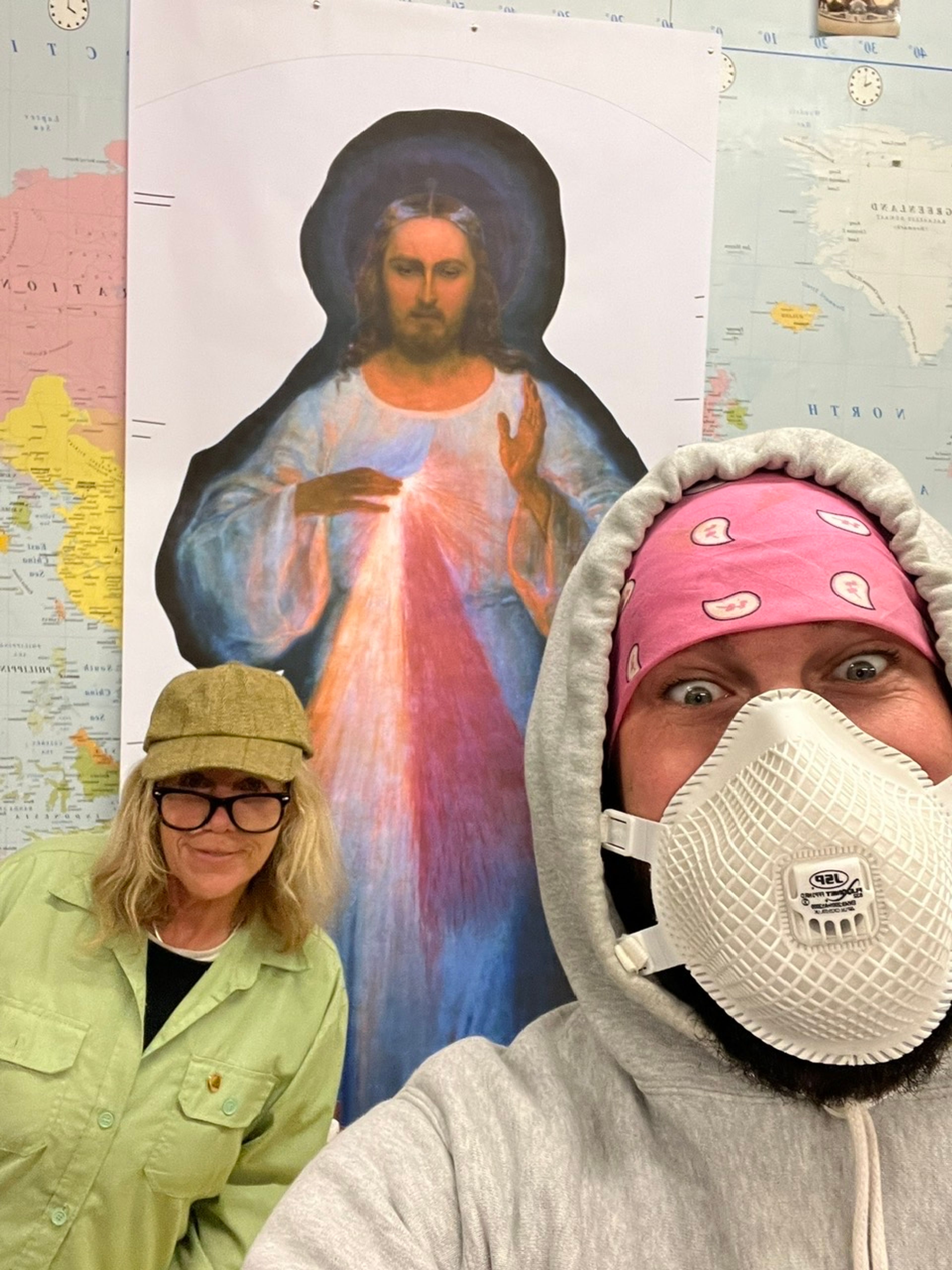
But if there was one person that influenced Ruairi the most, eventually steering him to pursue arts as an adult, it's his mom. His mom also spent most of her time in her own studio. Like mother, like son, Ruairi described it as somewhere that always had multiple art projects going on—a big place to make a proper mess, he explained. A mosaic artist who works on everything from interior design to a life portrait of Jesus Christ, her tools were a tweezer and a scalpel with which she set piece by tiny piece. Above all, her strength is color. "She's very fastidious with color combinations," Ruairi said. To this day, his mother's meticulous approach to and opinion of color remains a heavy influence on Ruairi's use of color. "Her visual opinions matter to me massively," he said. "She's a good critic on that front." His dad, meanwhile, started out at Shorts, a Belfast aircraft factory where, Ruairi says, he was one of the few Catholics employed—at the time, heavy industry was largely Protestant-held.
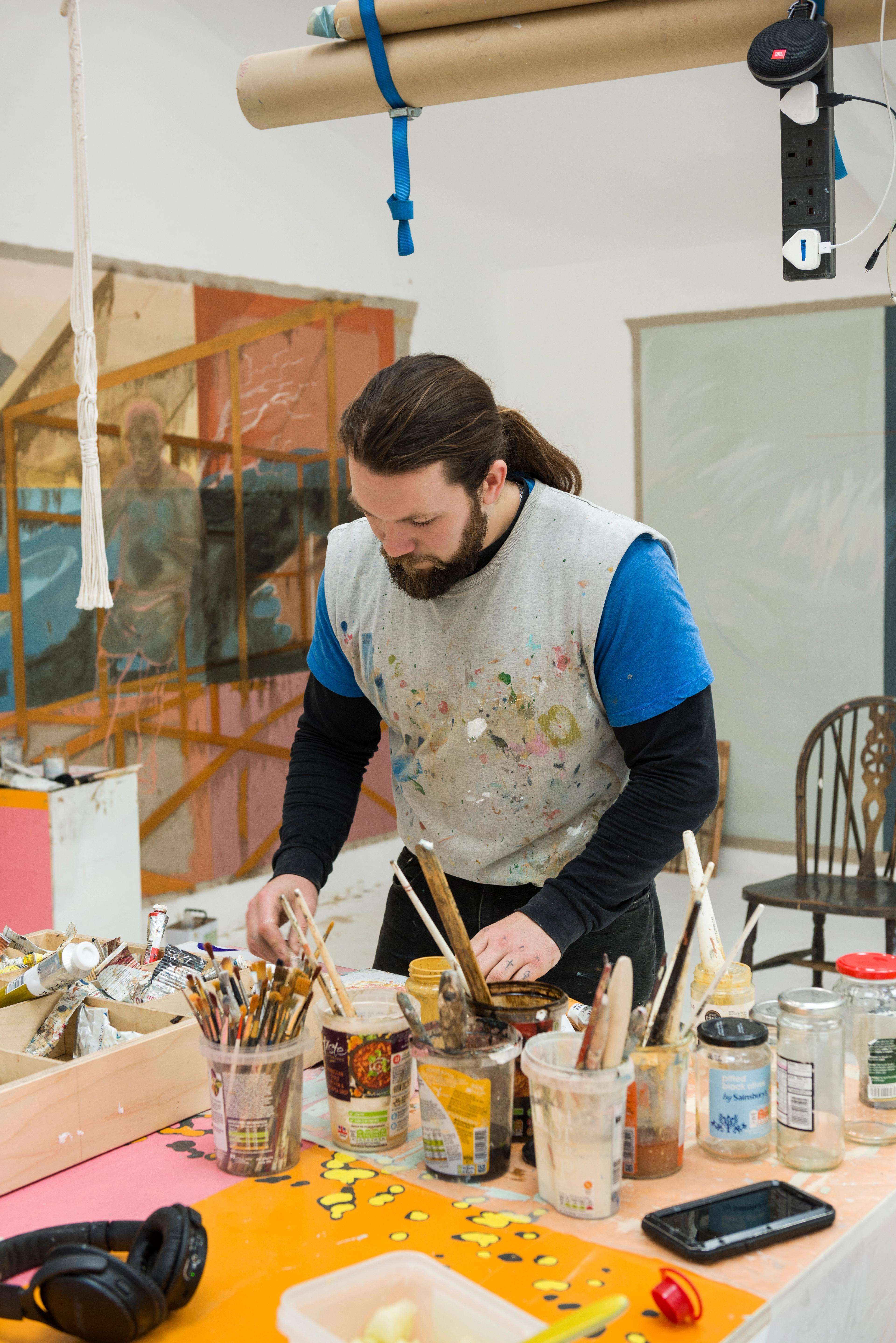
Feedback has always been important to Ruairi. Early in his life, positive responses from friends whenever he sketched out his Pokémon characters or created his own board games served as great confidence boosters. He called it cultural capital—the esteem granted by your peers that makes you feel worthy in a social hierarchy. Those personal interests, he explained, are what keep an artist going. He drew the same conclusion from rugby, recognizing early on the cultural capital he gained on the pitch. "It's kind of my attitude about everything," he added.
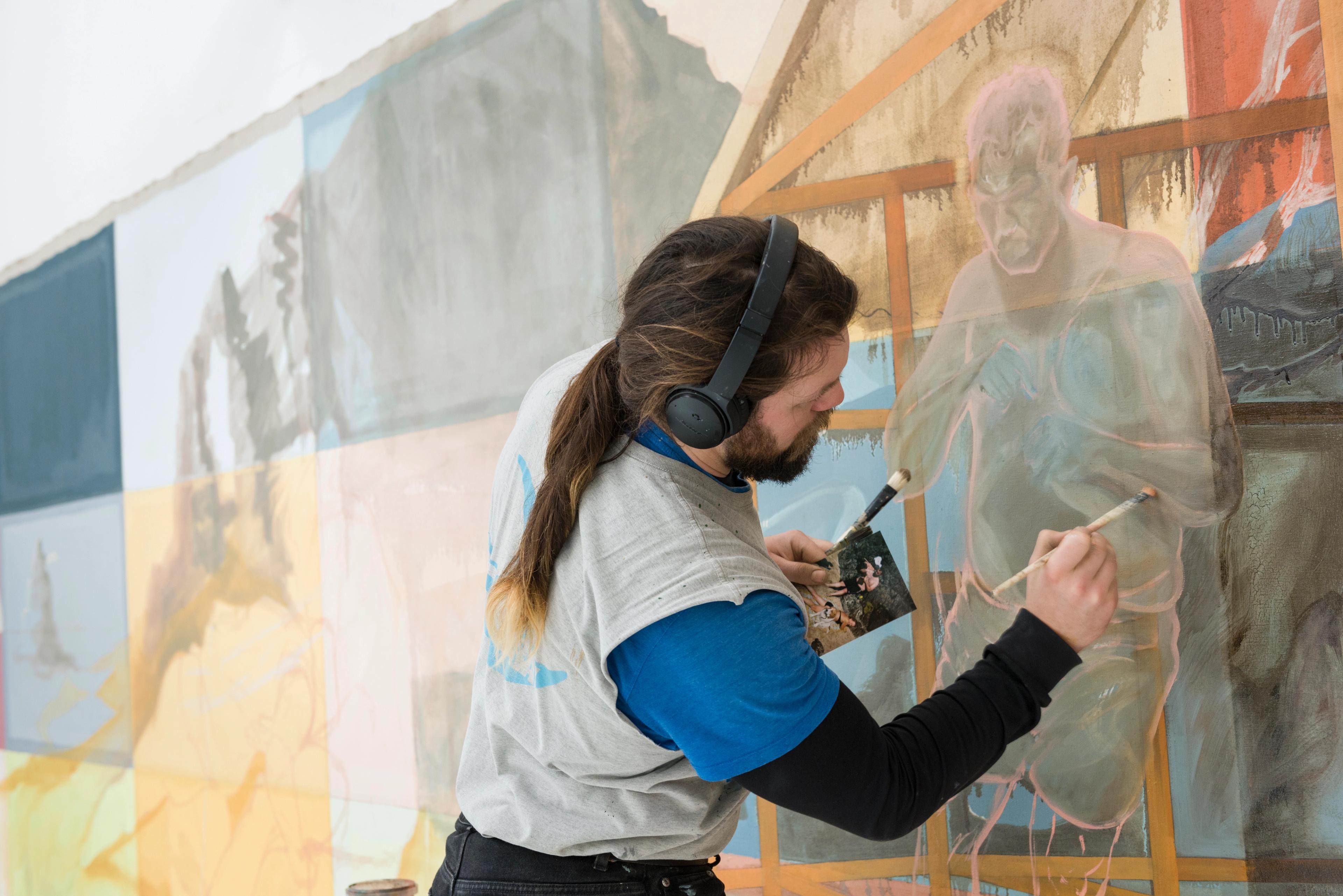
Ruairi's parents always encouraged him to challenge other people's perspectives and even society's expectations. It’s why he grew his hair down past his shoulders—a strictly forbidden practice in the Protestant school system. Although he comes from a Catholic family, he attended a Protestant school because Catholic schools didn't play rugby. After a youth spent frequenting his mother's art studio, by the time Ruairi finished high school in Belfast, his next steps forward were relatively clear: go to London for art school. Beyond the fact his mom's side of the family lives in London, the English capital was, as he put it, "where you go to do art."
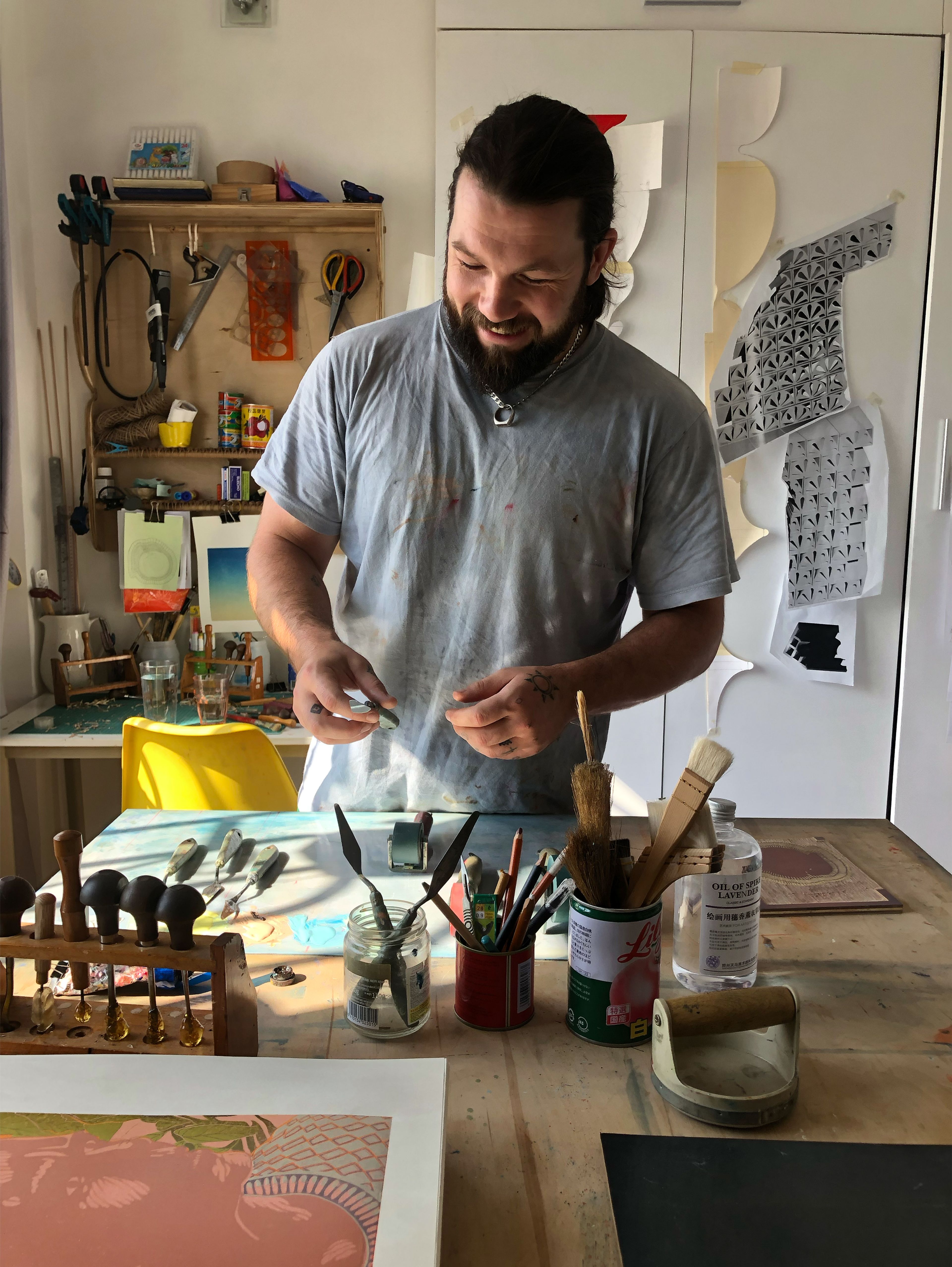
After moving to London, Ruairi began with a one-year Foundation Diploma in Art & Design at Camberwell College of Arts (UAL). He tried a bit of everything—painting, sculpture, illustration, product design, fashion—and from it all, illustration captured his attention, largely because he received positive feedback on his illustration projects and was happy to be guided. He continued into a two-year undergraduate-level Foundation Degree (FdA) in Illustration. His FdA program centered on the application of a functional approach to art. Students learned to produce projects that would generate an idea and develop your piece. Research and determining your target audience followed.
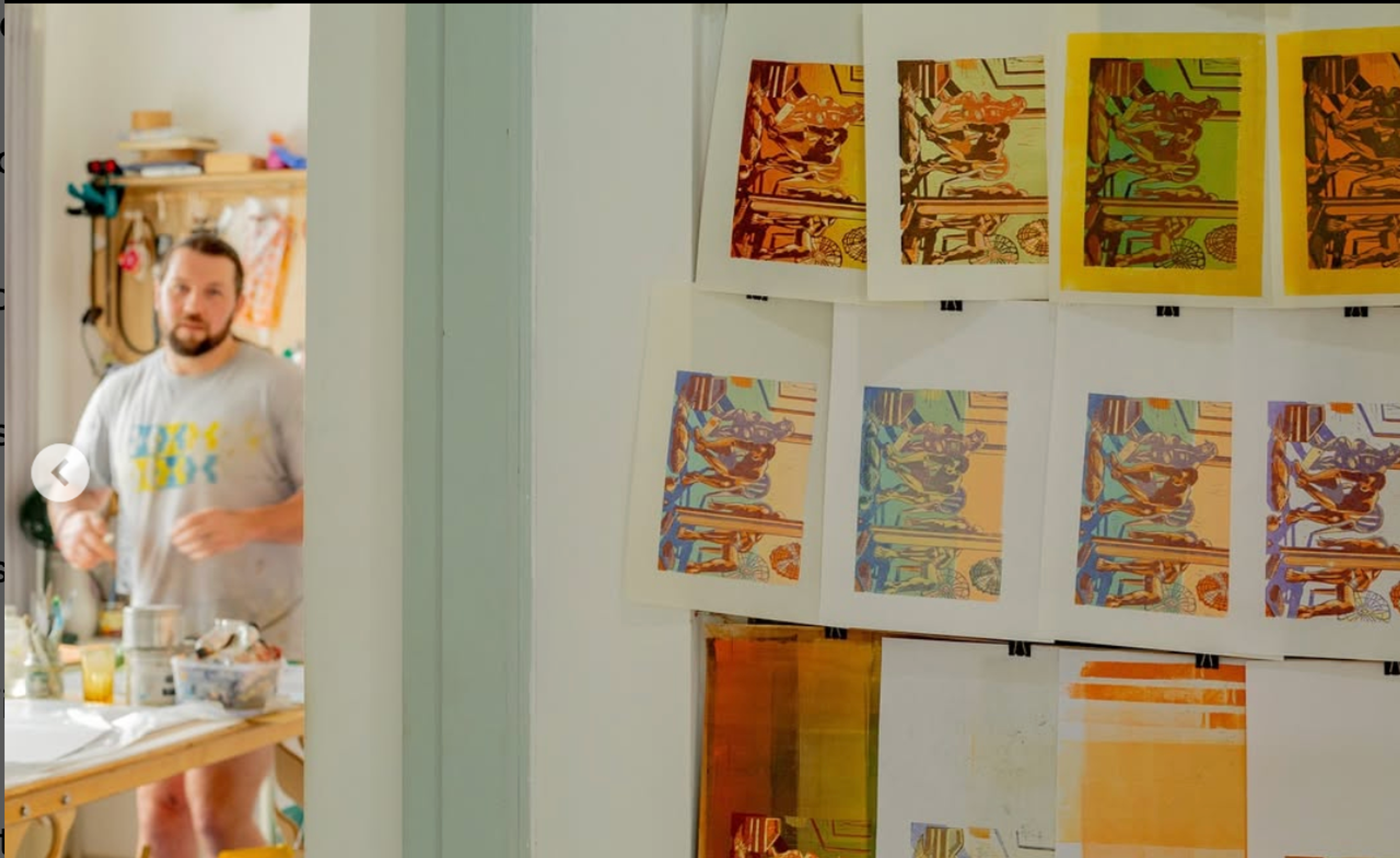
After that, he stayed on at Camberwell to pursue his Bachelor's Degree in Illustration. Having spent a couple of years focused on the functional approach, the goal for his BA program was to find his own voice, or as he put it: his positionality in the world. Ruairi's dissertation illustrated this best. Over the years studying in London, Ruairi made a living by working at an Irish pub. After so many nights speaking to regulars over pints, he had heard countless stories of Irish people who immigrated to the UK. In the process, he developed an interest and understanding of the troubles many experienced seeking a new life. The name of his dissertation, Tunnels to Turner, outlines the historical journey of Irish people as immigrants. Beginning as labour workers digging tunnels that built London’s infrastructure, his work traced their ascent all the way to 2014, when the Irish-born artist Duncan Campbell won the most prestigious art prize in the UK: the Turner Prize.
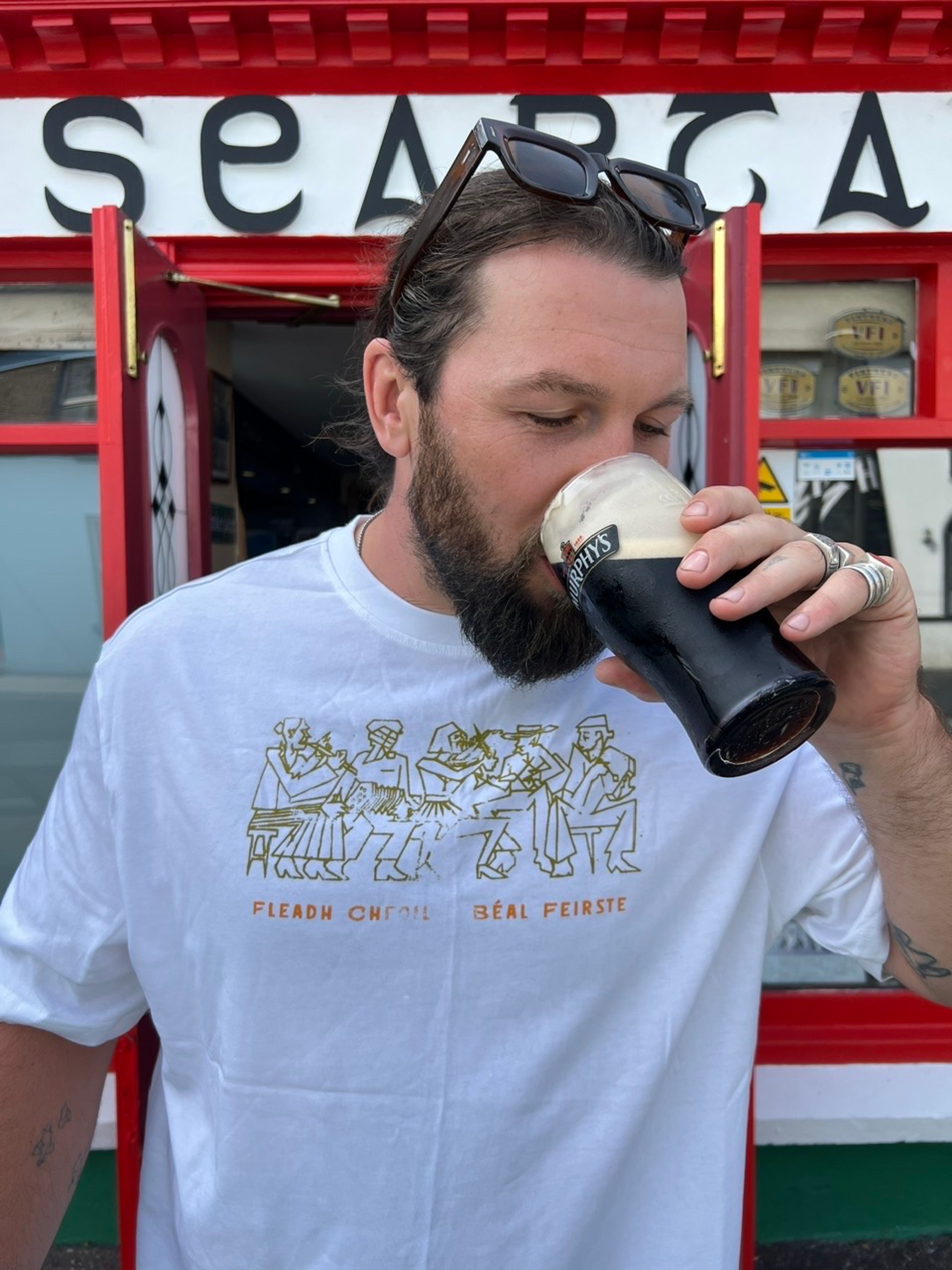
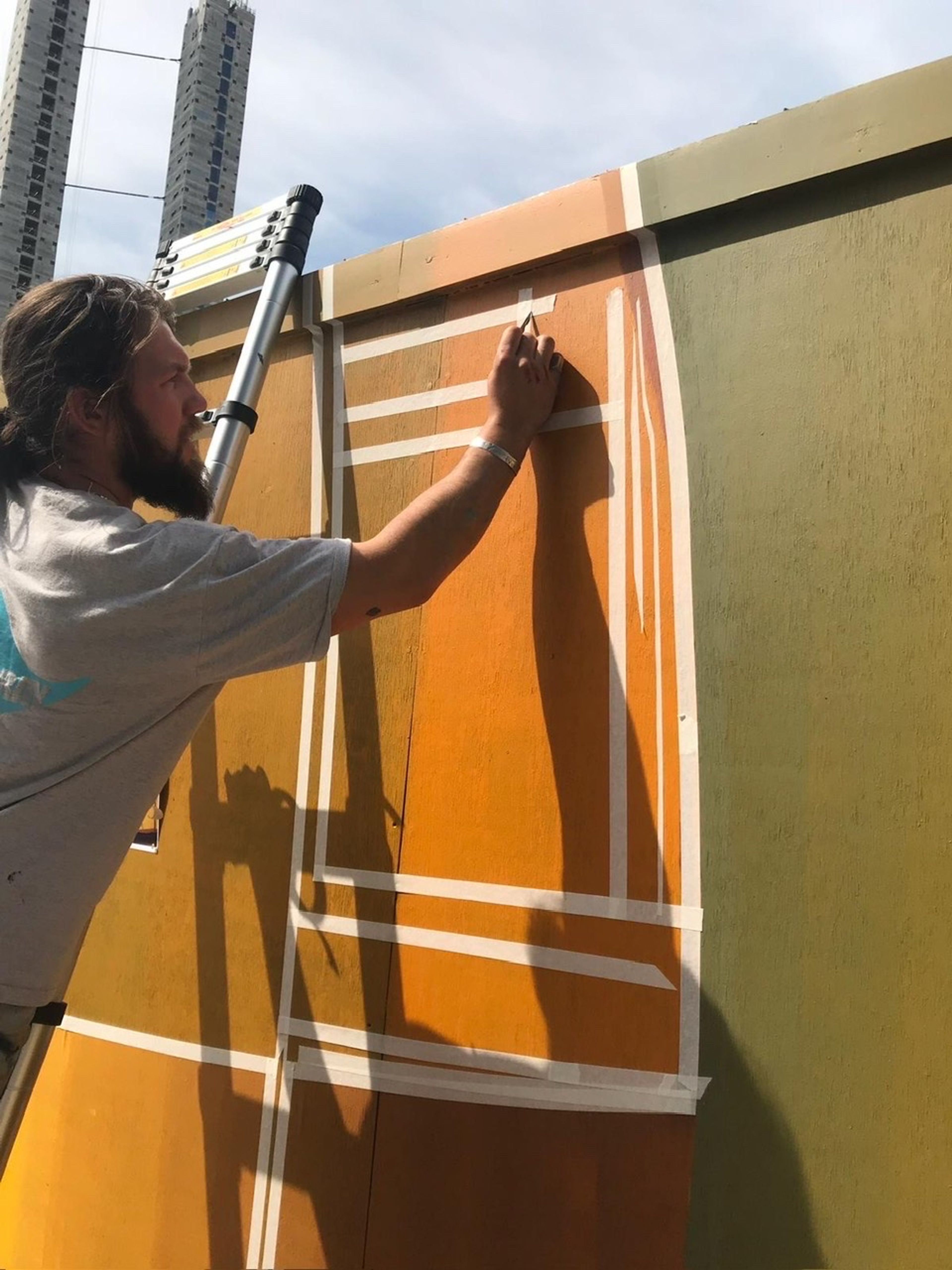
To showcase the changing attitudes of the Irish diaspora in the UK, Ruairi built an entire immersive installation inside the university—constructing a full-scale replica of an Irish pub right inside the gallery walls. Titled Flanagan's Bar, the name came from the university administration accidentally registering Ruairi Fallon under the generic Irish surname Flanagan. Inspired by the bar where he worked, the installation drew on hours spent drawing sketches of regulars—some in their nineties—as well devouring books and podcasts on Irish migration. Constructed from salvaged wood, doors, windows, hand-printed wallpaper, and carved wooden walls, the work even featured stout he brewed himself in his flat. Moving through the piece led viewers from an optimistic, bright entrance down into a dark, claustrophobic belly flanked by carved gargoyle-like figures of the pub's patrons, representing the isolation and alcoholism faced by many in the diaspora. If you have a chance to catch Ruairi outside of the studio, take the time to have him explain the cultural significance of how public perceptions of immigrants shift over decades. As Ruairi put it, "It was kind of meant to be a critique of British society rather than like, 'Here's a pattern that you could follow,' because lots of the stuff outlined the nonsensical regurgitation of bigotry within British society."
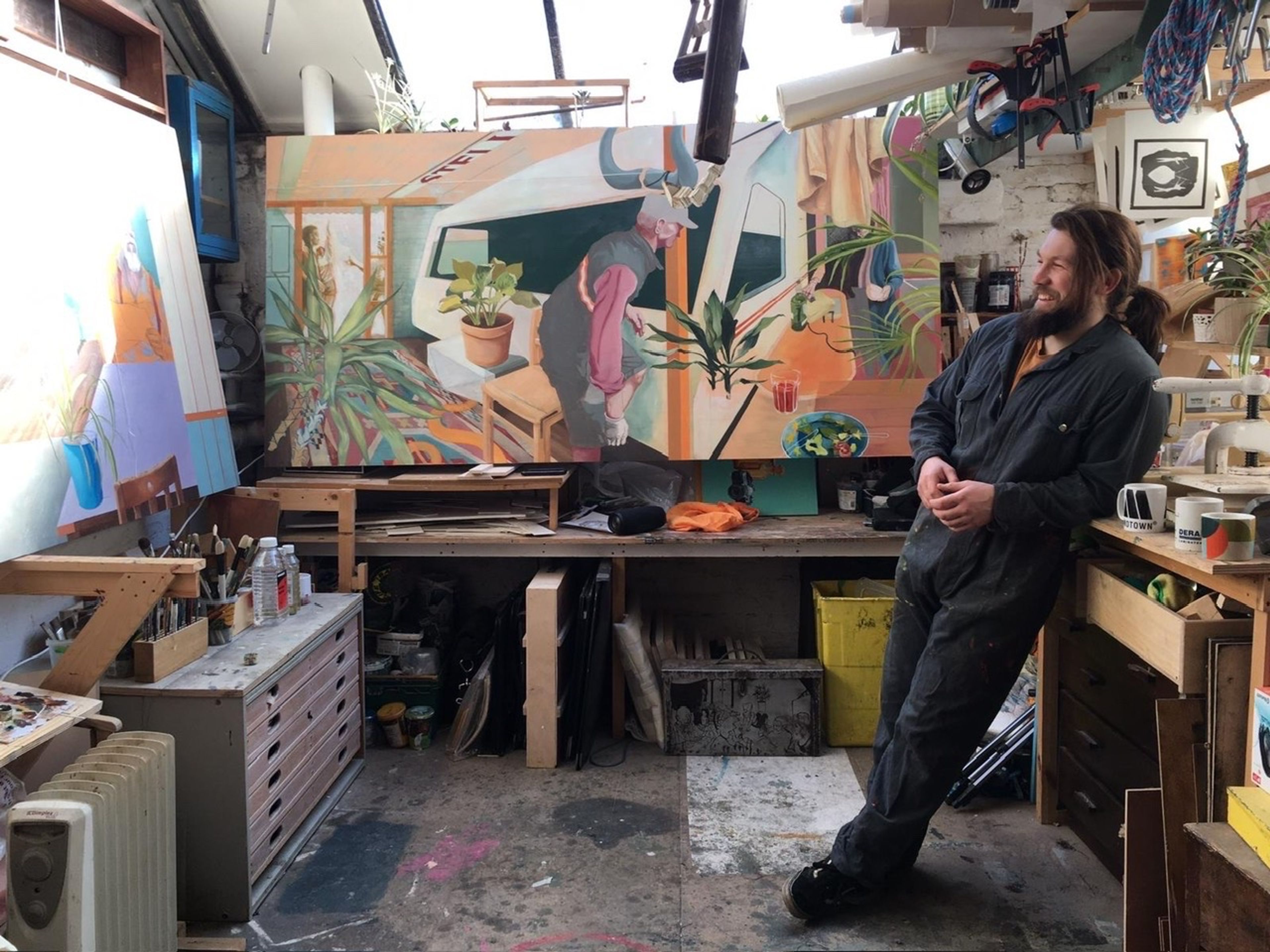
Following his completion of his FdA and BA in Illustration, Ruairi did what a lot of art students in London normally do after finishing their art degree: move into an art studio. That meant building a workbench with a mattress built inside it and a removable top. He’d use his desk for artwork during the day and then at night he’d cuddle up in what he described as a coffin-style bed. Coincidently, the first studio he lived in had no windows, similar to the studio we chatted in. In his eyes, being an artist was all about living frugally enough to focus his energy on his work.
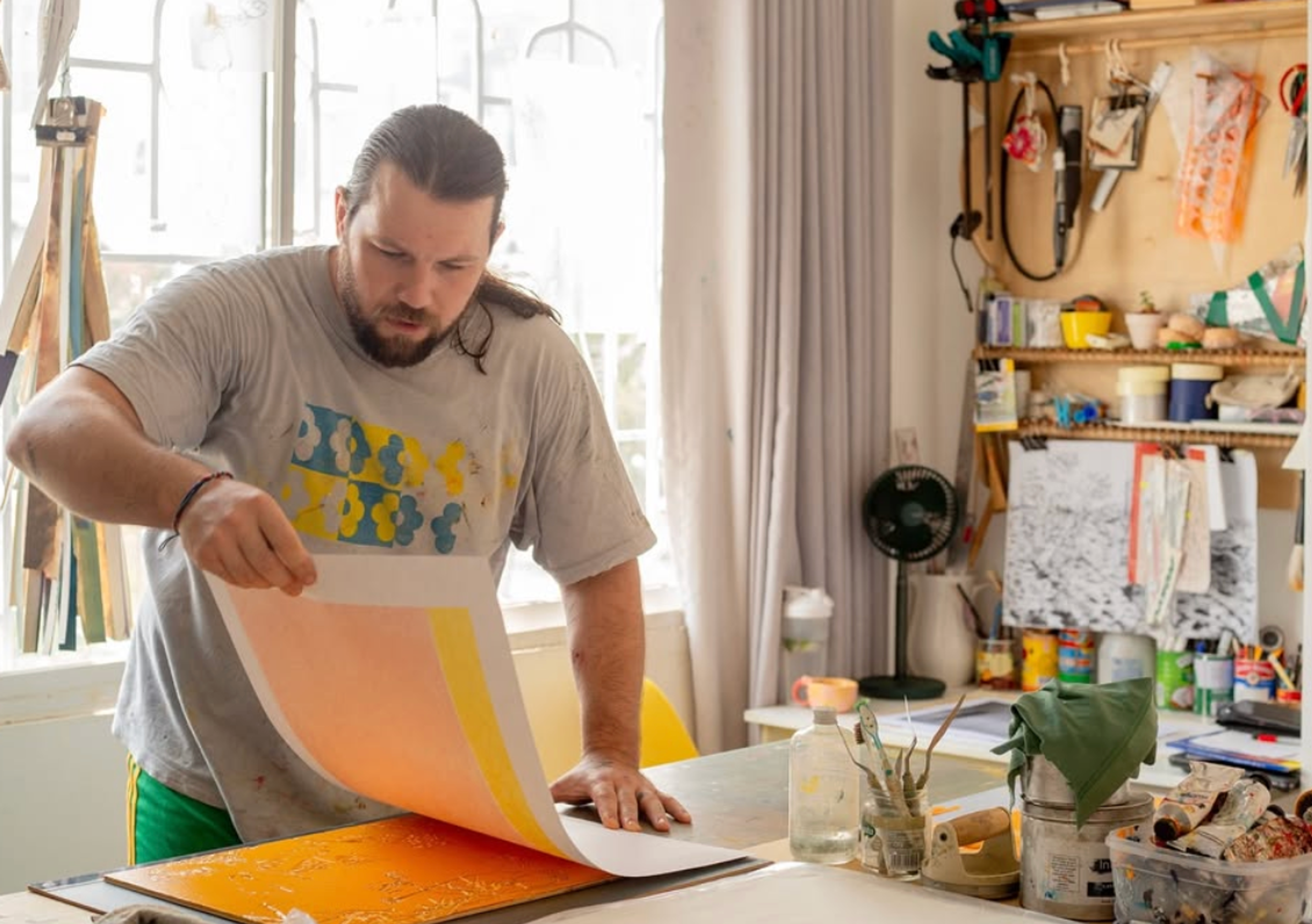
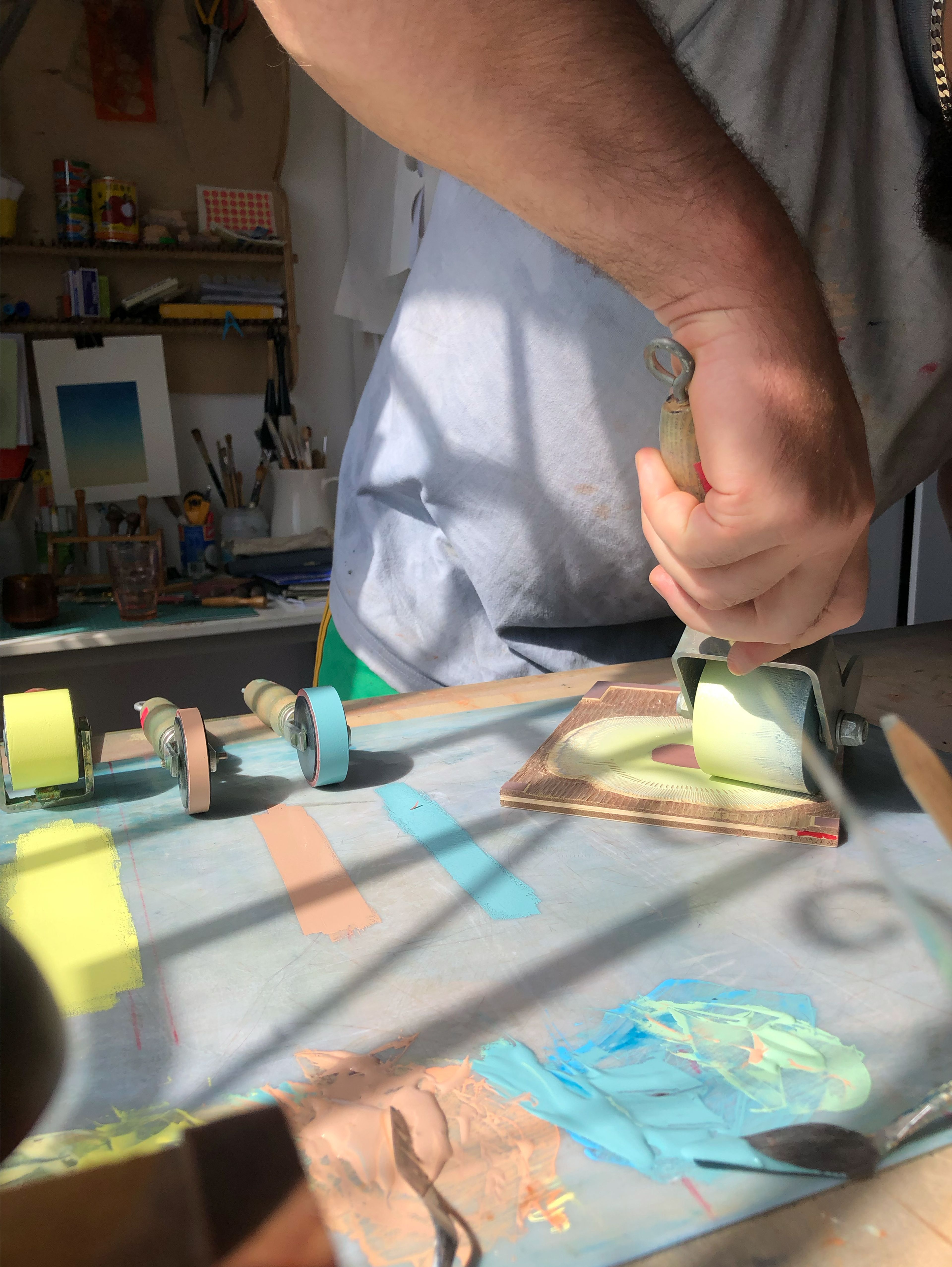
Around this time, the awards he won for his installation also earned him a year of free access to Thames-Side Print Studios. He had acquired a small Victorian bookbinding press at an auction in Belfast and taught himself reduction printmaking—moving away from black-and-white to multilayered color works derived from old family photographs, such as a family portrait from his father's travels in Tanzania shown alongside an image of a Belfast riot. In 2017, two of these reduction prints were accepted into the prestigious Summer Exhibition at the Royal Academy of Arts in London—showcasing the idea that printmaking could form a sustainable core of his practice. Exhibited together without explicit context, the Tanzania and Belfast prints were often interpreted by audiences as depicting apartheid-era South Africa. It was a formative moment for Ruairi. He realised that layering seemingly disparate references over one another allowed the work to speak to broader human experiences, rather than sticking to a singular, more specific narrative.
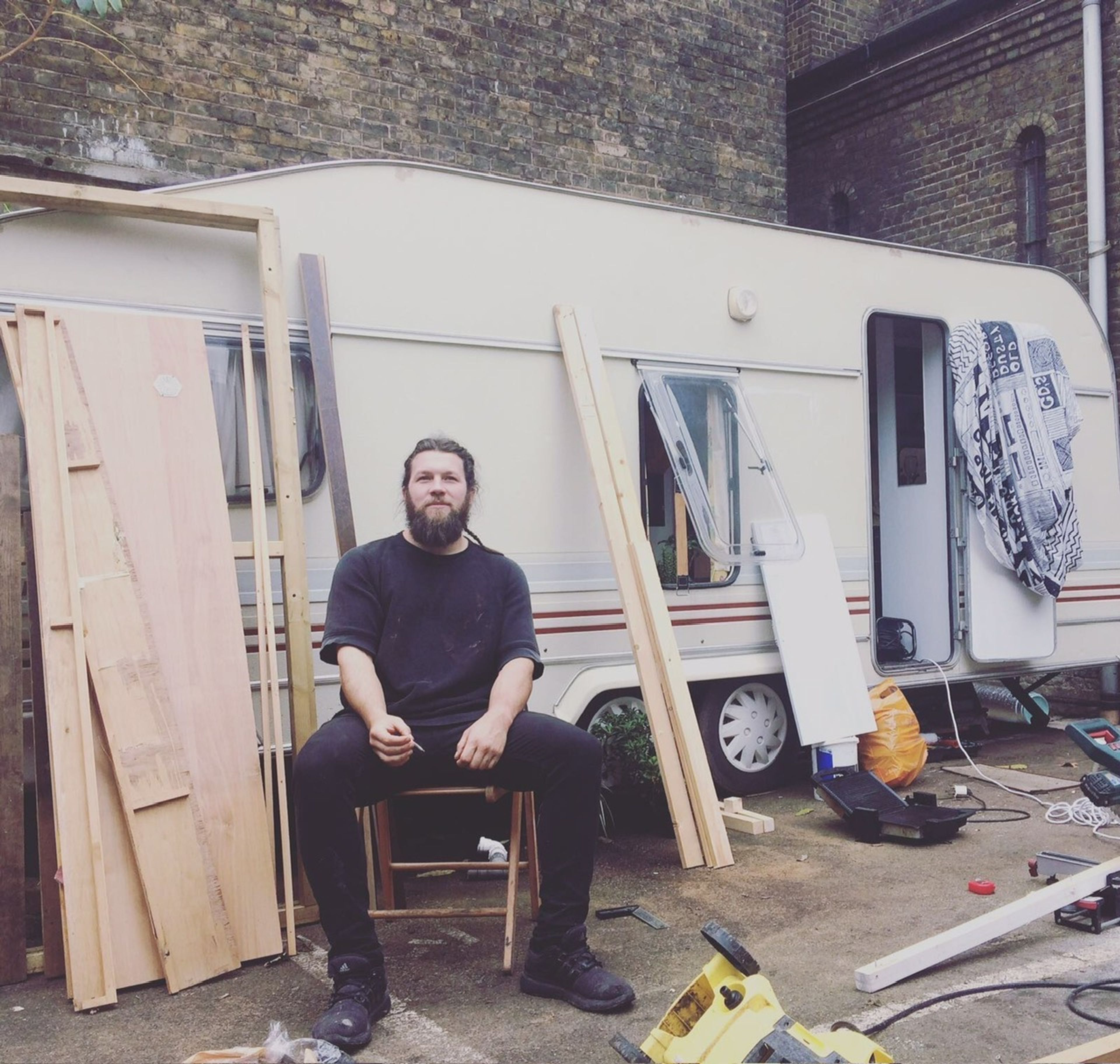
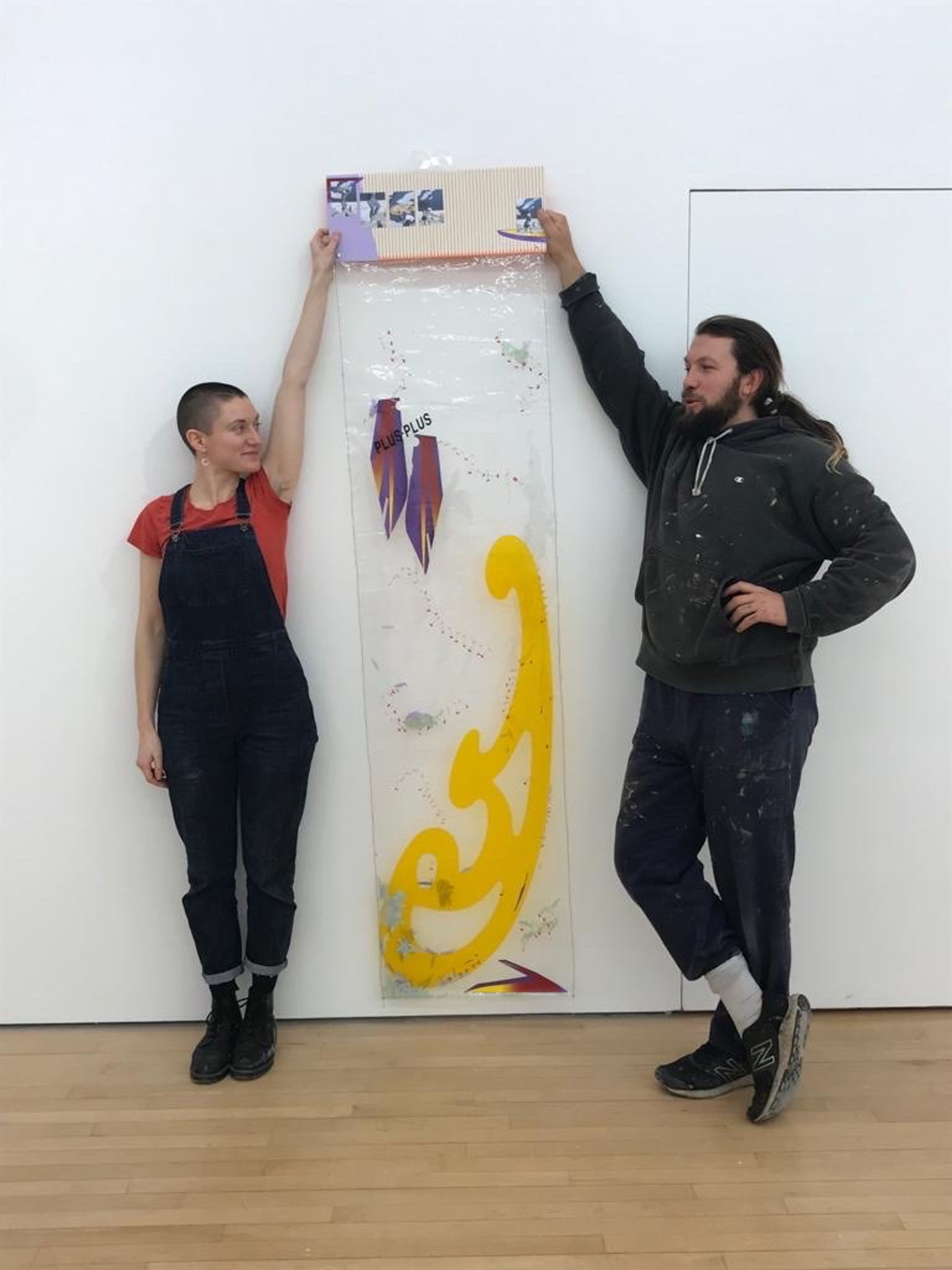
Later, he lost his spot in the art studio and had to find another way to manage his expenses to make room for art. He transitioned from living underneath a workbench to living the caravan life for a few years. Throughout these tumultuous London years, Ruairi supported himself by working at a pub, a local vintage market, and a set-building company where he helped make props for plays, films, and television shows. Having access to the set-building workshop allowed him to revisit sculpting, an art form that had taken a backseat after university. Finding it difficult to exhibit the full breadth of his work—galleries preferred showing his printmaking or paintings in isolation—he staged a self-initiated solo exhibition in 2020 titled A Fork in the Road at AMP Gallery in Peckham. The show compiled etchings, large-scale paintings, reduction woodcuts, multimedia sculptures, and fabric appliqué works created in collaboration with his then-girlfriend and now wife, Chloe. Even with his often unstable lifestyle, two things remained constant throughout: his relationship with Chloe, and his commitment to art. As he put it, "The arts are constant, so the art’s never not happening."
Ruairi ended up living in London for twelve years. Of the various artistic pursuits he’d been involved in,the two most worth highlighting were his time collaborating within an art collective and a club. The first began with a dicey call. Skipping his pub shift on St. Patrick’s day, its busiest day of the year, Ruairi trespassed into a junkyard with friends to build a sculpture. The project came together at sunrise, a mess of stacked fridges and scaffolding that cost him his job at the pub but was more than worth the loss.
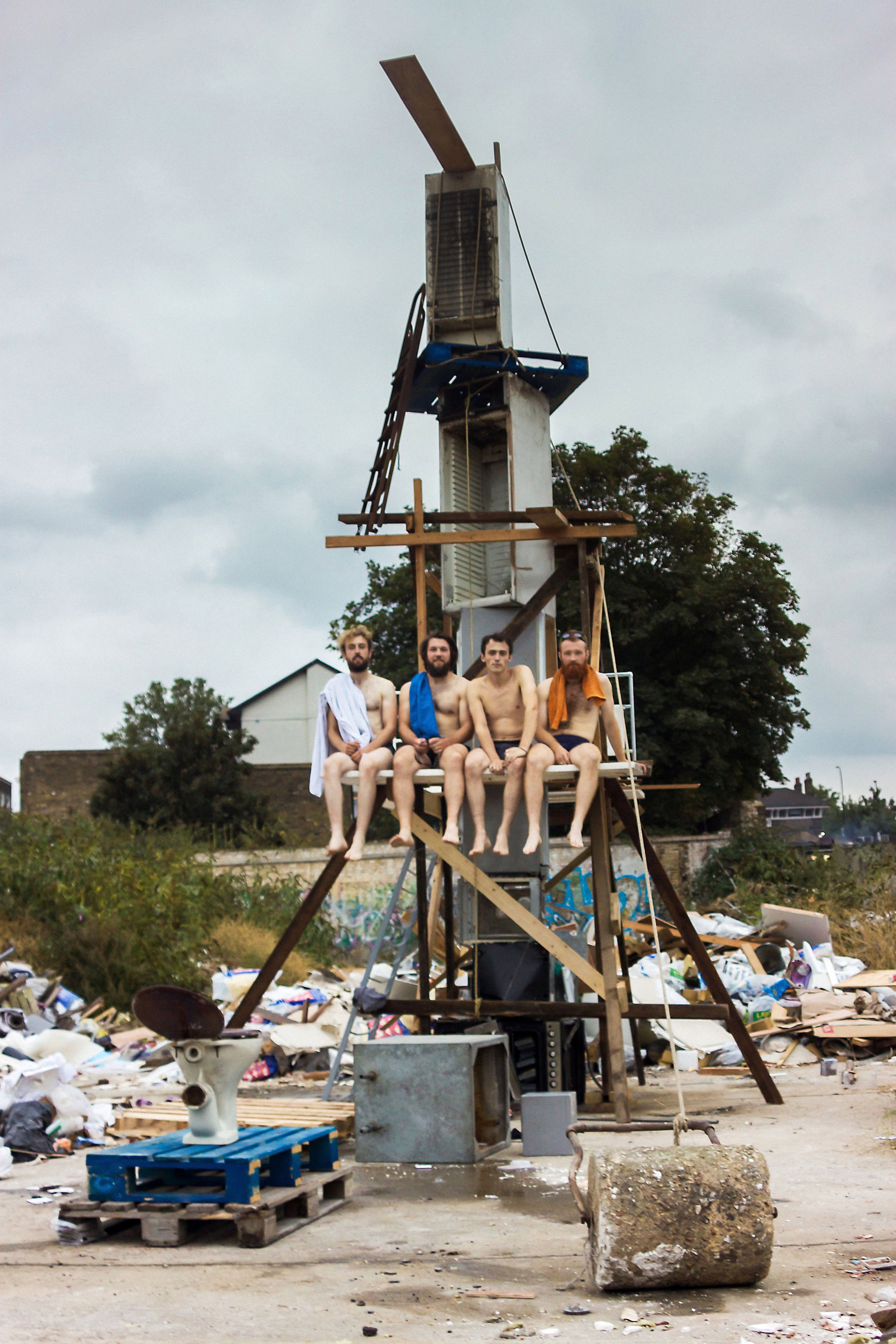
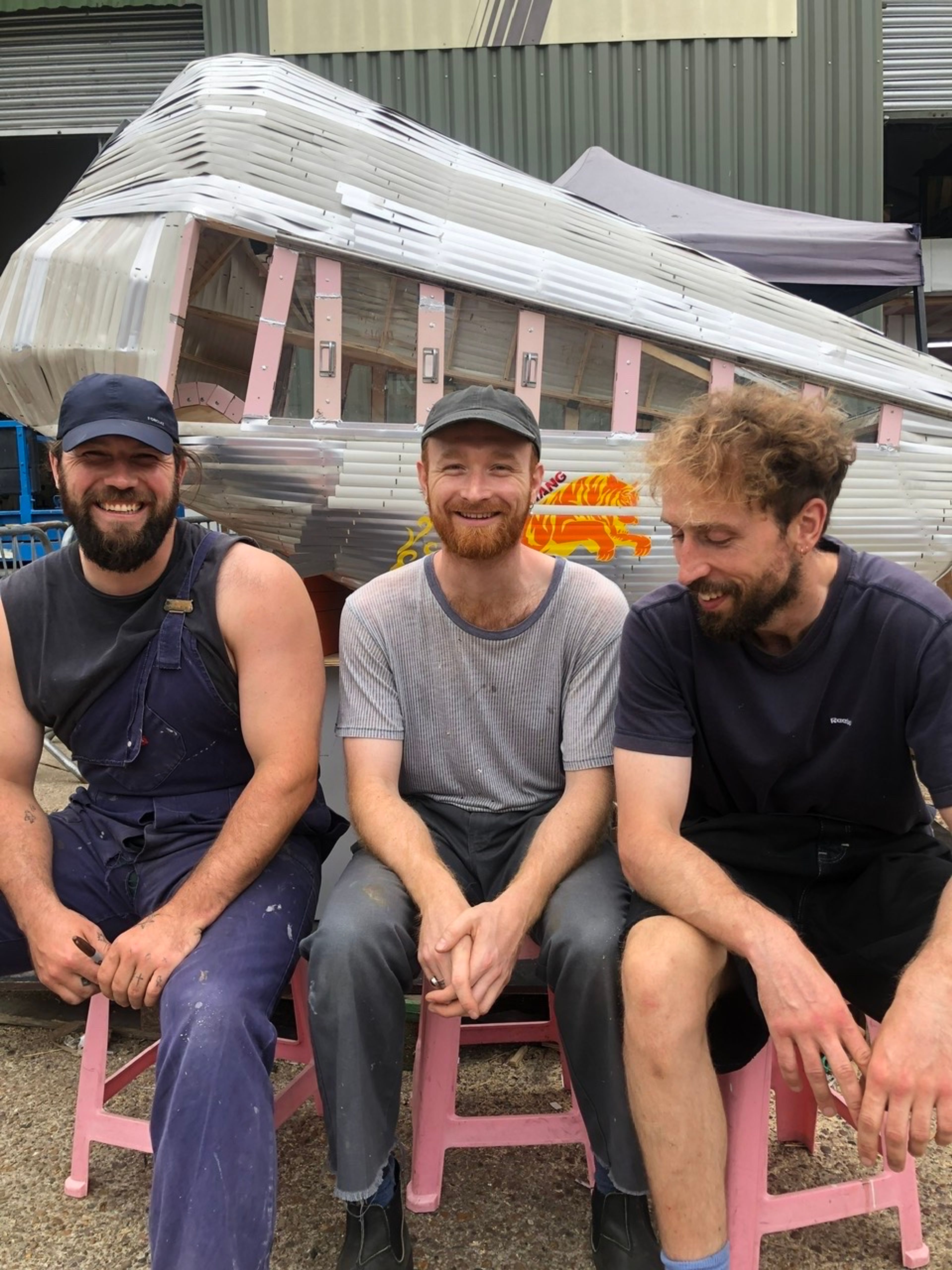
That spark grew into F.A.F., an art collective that went on to reside in a self-built shanty compound behind the railway tracks at Flat Iron Square near London Bridge. Ruairi and his collaborators stayed in caravans in exchange for running a vintage market. Blurring the lines between daily survival and art, they later built a three-story greenhouse structure from salvaged sash windows in response to London's housing crisis. Outside of F.A.F., Ruairi was also a founding member of Crit Club, a group formed in 2019 with university friends to present work, exchange peer feedback, and share skills. In 2021, they held a group exhibition at Staffordshire Street Gallery. Some of the art made by his peers within the Crit Club still resides in his living room where we chatted.
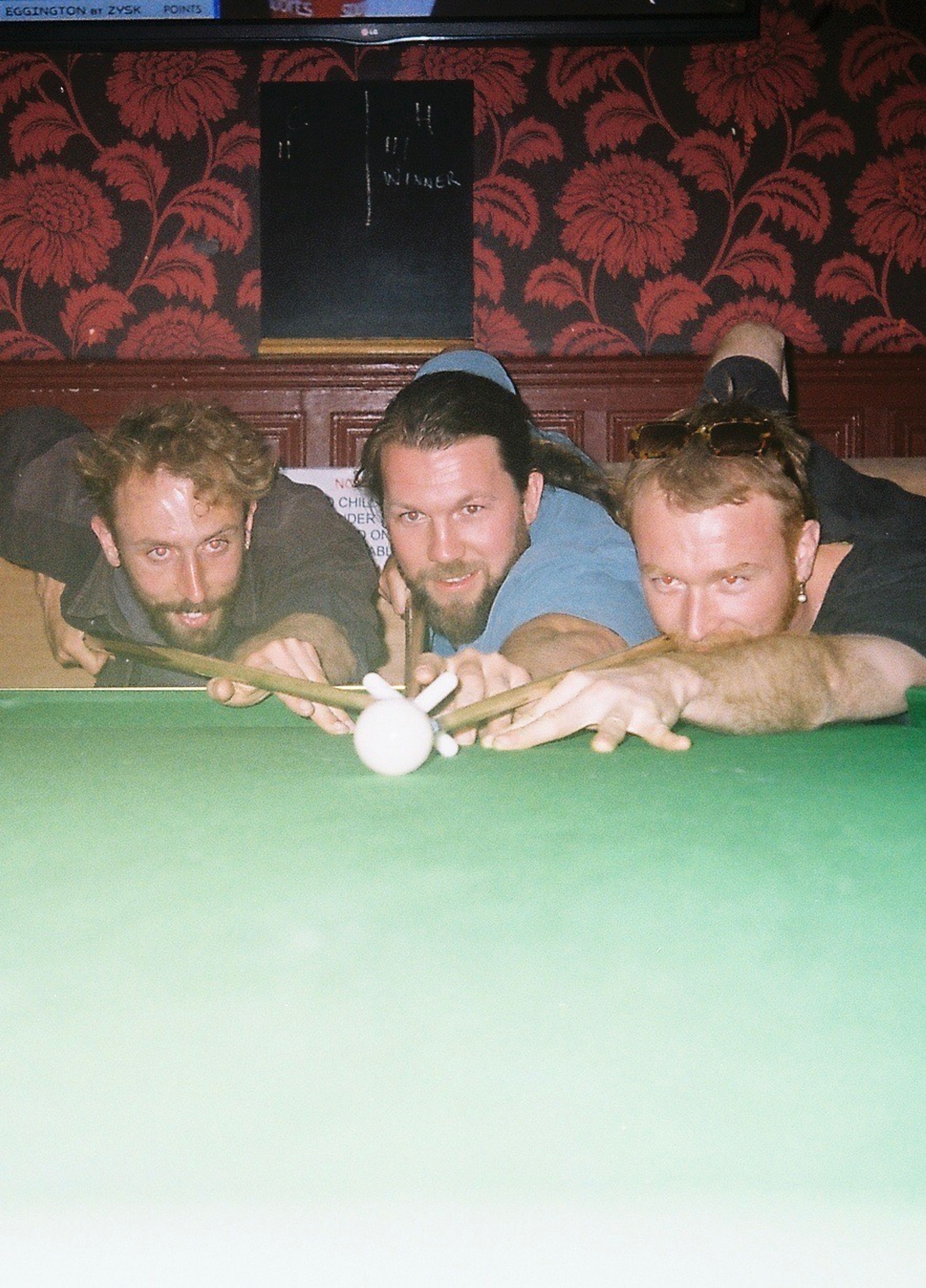
Things were moving along and Ruairi was making everything work until a huge change took place with his partner Chloe deciding to move. She had been working as an Art & Design teacher in the English school system for years and craved a change. For one, she became disgruntled with her work and two, the lack of opportunities for purchasing property in London made it evident that leaving the city was the best path forward. She had always wanted to live abroad and settled on Vietnam after hearing many teachers praise the country for the lifestyle it offered. The two came to a decision. She would move first and get settled in while Ruairi would finish his remaining art shows and join her a year later.
With his most constant and stable presence away, Ruairi felt unable to relax and rather worked himself into the ground in her absence. "I developed anxiety through a combination of nonstop working on projects that I couldn't quite afford, and overdoing it on every level." Put simply, he pushed himself past his limits. The London years had already produced work like his 2022 solo residency exhibition, Future Memory, at Unit 1 Gallery—painting from a massive archive of personal and found photographs to collapse time onto two-dimensional surfaces. In Chloe's absence, though, the pace went further, with 20-hour workdays for weeks on F.A.F.'s major exhibition, As a Child with a Matchstick Castle, at Staffordshire Street Gallery in 2023. The collective traveled to Belfast for a week-long workshop to get guidance from Ruairi's mom on the intricate mosaic work, inspired by the Roman mosaics discovered beneath their evicted caravan site.
Furthermore, Ruairi explained how he isn’t good at relaxing. The only way he has a chance of settling down, like watching a television series for example, is when he spends time with his partner. Case in point: the most relaxed I saw him was the moment his wife Chloe returned from work. Although he kept speaking at the same speed, the tension in Ruairi’s shoulders noticeably eased. Art, on the other hand, although therapeutic and joyful, offers more of a release than a channel for relaxation. The same goes for playing rugby or going for pints with friends. They helped give him a sense of release but without an accompanying sense of recharging. Therefore, during this period back in London, Ruairi pushed himself to exhaustion. In listening to him describe this time, there didn't seem to be a point of resolution. However, as agreed upon, after a year of long distance, Ruairi relocated to Saigon in 2023. It was time for him to explore a new frontier of his artistic existence.
Arriving in Saigon, untethered from his family and friends thousands of miles away, Ruairi recalled trying to make his way into Saigon's art scene like a kid showing up on the first day at a new school. In contrast, joining a rugby club like the Saigon Geckos was simple. It's not that hard to make friends after sharing tackles on the pitch and drinks afterwards. But the art scene was different. He felt awkward, uncomfortable, and nervous. He further noted it can be difficult to interact in crowds you’re not used to as shyness can be mistaken for arrogance. After spending over a decade building a network and reputation in London, he had to start again. Ruairi gradually met people he felt comfortable around. The turnaround started a chain reaction. First he met curator David Willis after participating in a group show at A. Farm Gallery. That connection led him to Fred Farrow, owner of Studio Red Arrow, and eventually to Adrien de Calvairac, founder of 11:11 d'Artistes. Adrien contacted Ruairi about taking part in Moiré, a trio exhibition alongside Jesús Briceño Reyes and Fred.
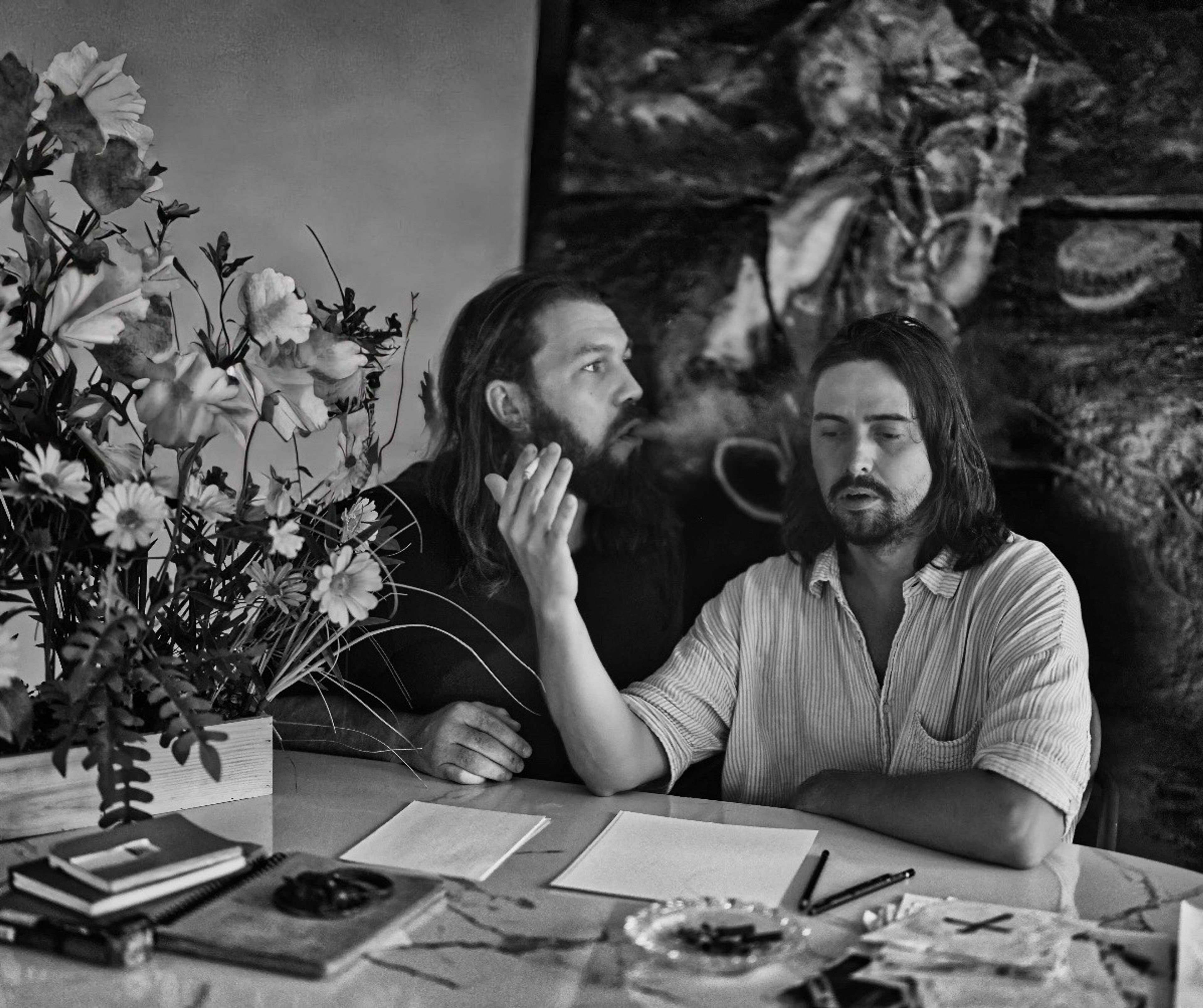
According to Ruairi, Moiré took its name from what’s known as a Moire pattern, an optical interference pattern caused by overlapping grids. This allowed Ruairi to create a visual motif of separation symbolic of the feeling of otherness he was now existing within. He explained that the series steered away from direct portraiture. Instead it looked at the human figure and focused on a surreal indirectness: distorted smiles reflected in bike wing mirrors, ephemeral moments obscured by exciting architectural details. Having a deadline for the show forced Ruairi to consolidate the complicated ideas in his mind. This became his first big stamp on Saigon's art scene.
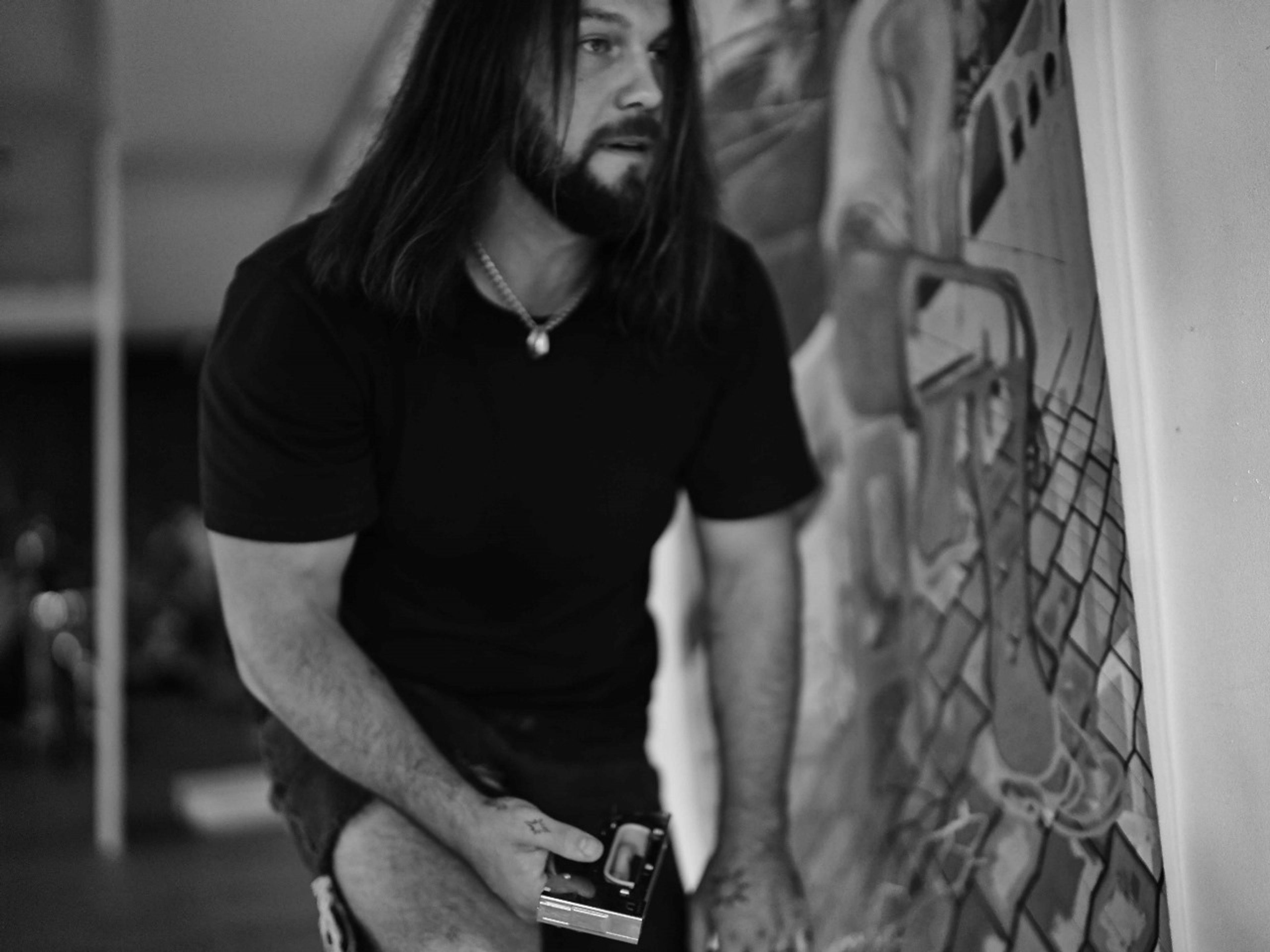
Since that breakthrough, his momentum’s only picked up as he continues to bridge his two worlds—Vietnam and back home. In 2024, having already established his new home in Saigon, Ruairi returned to London to help mount All I Could See Through the Porthole Was Glittering Dust at Split Gallery in East London—a solo F.A.F. exhibition centering on a fantastical trebuchet structure carrying a pod of office and domestic detritus, complete with subtle nods to Vietnamese paraphernalia, representing a low-fi dream of escape in a tech-fueled apocalypse. It was the first time Ruairi developed work on that scale from afar that was delivered and installed across cities, proving that he could maintain an active presence in the UK art world even while living abroad.
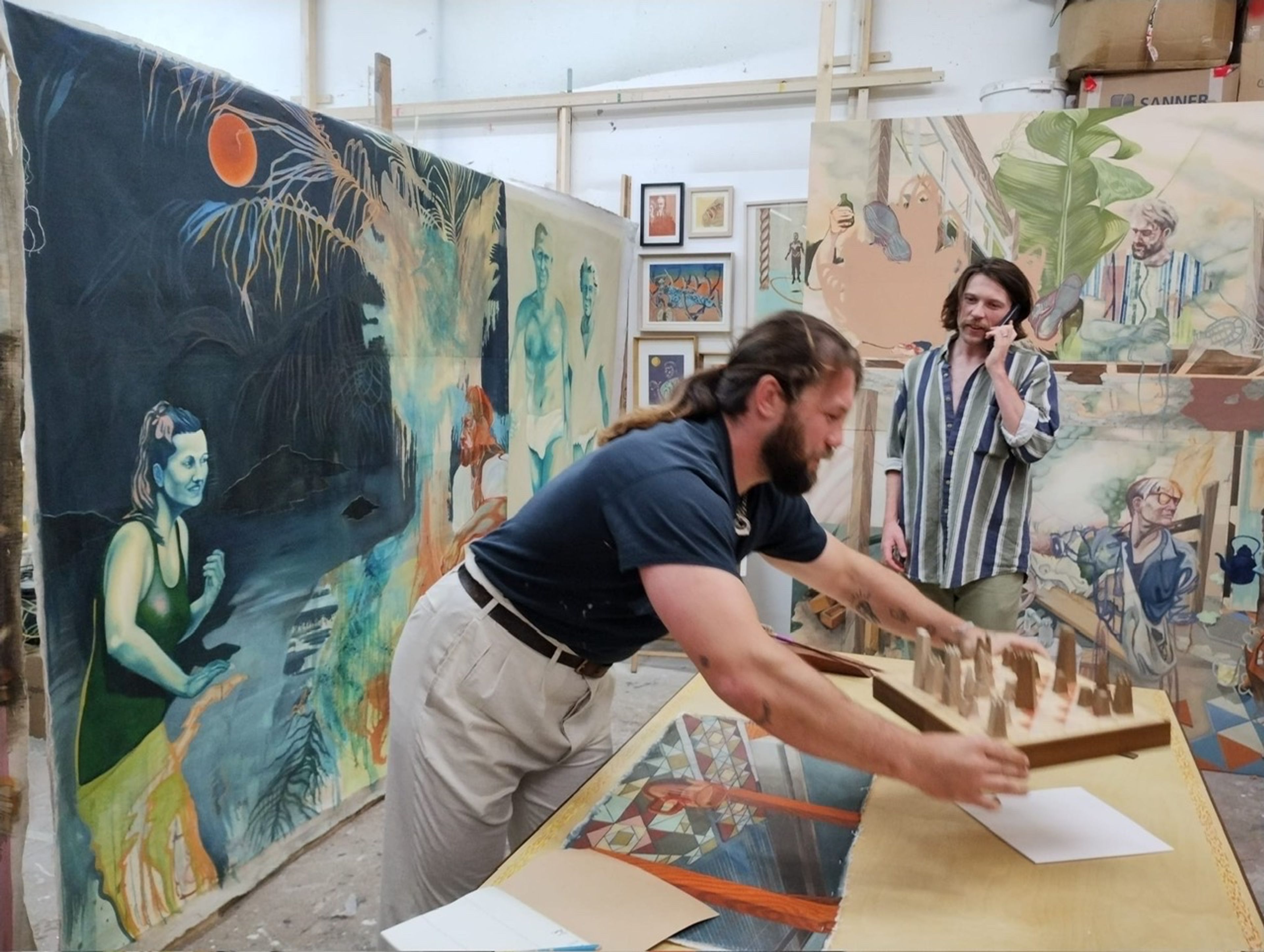
Alongside his international projects, he has continued curating local shows like the Red Arrow Summer Open Studio while exhibiting at the Ulsan International Woodcut Print Festival in Korea and the Royal Ulster Academy in Belfast. In 2025, his year-long reduction woodcut project Scattered Broken Maybe showed at both Studio Red Arrow in Saigon and La Roche House in Belfast. Layering dreamlike, dystopian references from Vietnam directly over references of home allow the viewer to question how we process visual information in an overly saturated world.
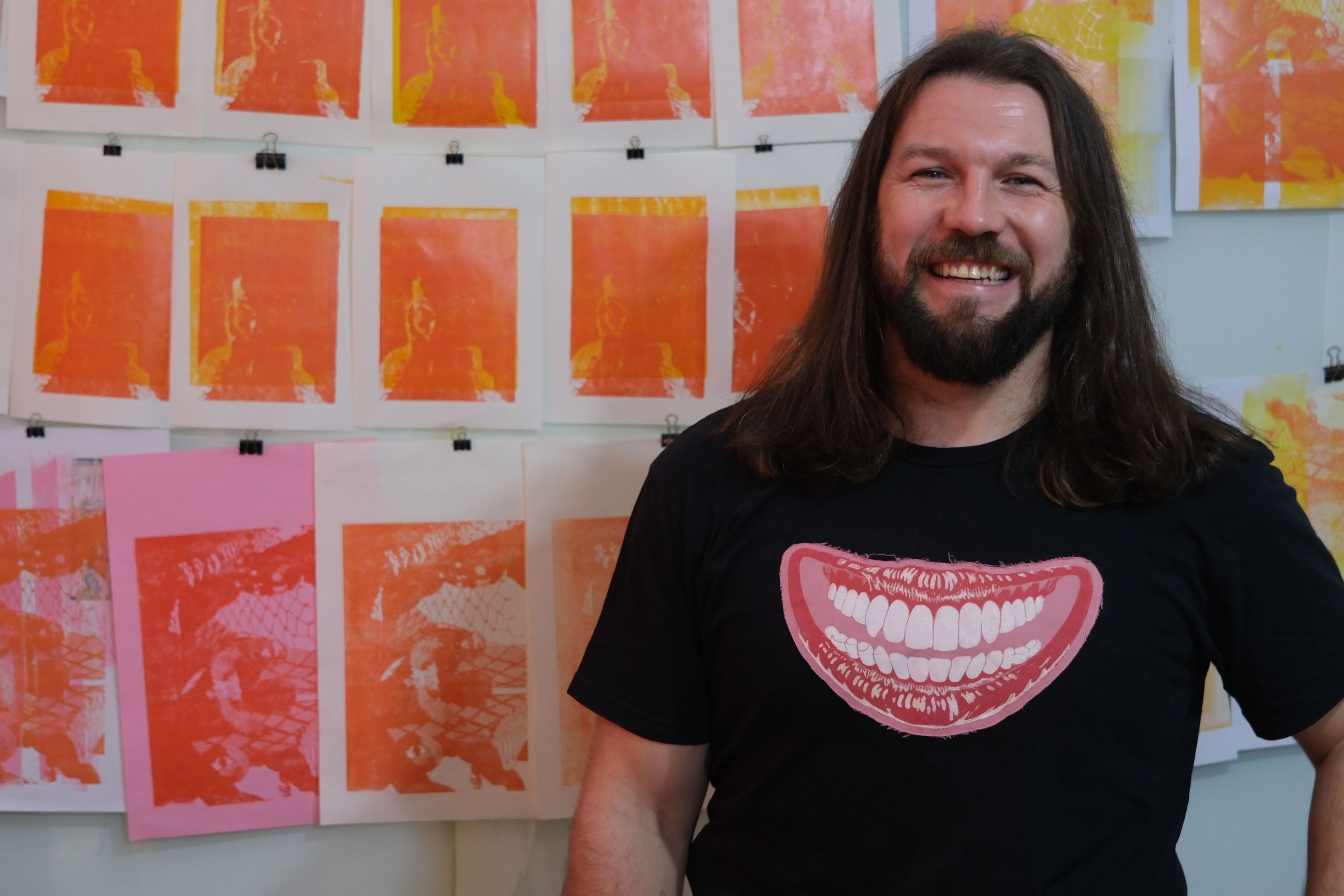
Although Ruairi’s creative processes can vary from spending all day in his studio or scouring markets around Saigon for material for his art, the work itself always comes from within. Through his personal perspective and the commonalities he notices in the collective human experience—whether that’s throughout history, society, identity, politics—he’s always attempting to make works that visually represent the feelings he has and what they mean to him. Furthermore, he also hopes to push himself even more by building bigger and bolder art installations alongside others here in Saigon. As he noted, collaborating with others—the playfulness, the physicality, the messiness—is where his true joy in art lives. As for his future goals he understands the vulnerability in being an artist never disappears. Ruairi summed up his thoughts on his mindset as follows: “The intention is to still be making art in my 70s. I get a lot of therapy and joy out of it. It says a lot that no one even knows what I'm making at the moment, but I still stand at that wall for eight hours a day and paint. No one cares if I'm doing that, do you know what I mean? It doesn't really serve a purpose. So the aim is that life doesn't catch up with me and take it off me. That's the goal.”
Follow Ruairi on Instagram and his website